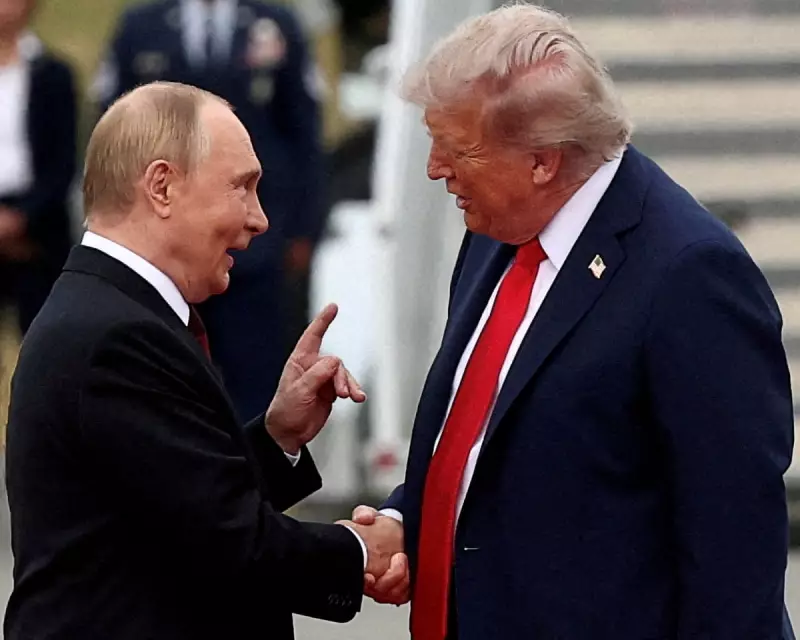
A revealing photograph from August 2025 captured a moment of significant geopolitical symbolism: former US President Donald Trump and Russian President Vladimir Putin meeting in Anchorage, Alaska. This image frames a deeper analysis of their parallel motivations and the profound threat they collectively pose to the European continent.
The Psychology of the Spoiler: Craving Respect Through Disruption
Experts argue that Vladimir Putin's war on Ukraine is driven not merely by imperial ambition, but by a profound sense of disrespect. Russia, once a superpower, now feels dismissed by the international community—a sentiment crystallised when Barack Obama labelled it a "regional power". Unable to regain genuine admiration, Putin has opted for a strategy of fear and disruption.
Similarly, Donald Trump's adversarial stance towards Europe stems from analogous roots. While he receives deference from some autocrats, Trump and his officials are acutely aware that many democratic leaders view his worldview with contempt. Europe, with its entrenched commitment to multilateralism and the rule of law, represents a system of prestige that fundamentally undermines Trump's desired world order.
The shared goal is to act as a spoiler. When locked out of a social hierarchy that regards you as inferior, the incentive is to smash that hierarchy entirely. For Putin, this means revanchist aggression. For Trump, it means dismantling the very liberal international system that the United States painstakingly built.
The Irony of American Demolition
The post-Second World War order was a uniquely American creation. Successive US administrations, both Republican and Democratic, championed a vision of a world shaped by democratic values and legal norms. This project, despite its frequent hypocrisies, formed the cornerstone of immense American "soft power"—the ability to lead by example.
The European Union stands as this order's greatest achievement. Initially nurtured by US aid via the Marshall Plan, the EU evolved into a cooperative regime based on law and liberal democracy. It expanded eastward after the Cold War, demanding democratic reforms from new members. In many respects, modern Europe came to embody the ideals of the US-led system more purely than America itself.
Now, the Trump administration explicitly seeks to break this system apart, replacing it with one founded on raw power and naked national self-interest. Its national security strategy paradoxically claims to want to maintain US soft power while rejecting the multilateral framework that generated it, boasting instead of an "America strong and respected again."
A Strategy of Venom Without Capacity
The reality, however, is that this respect is not forthcoming from liberal democracies. Allies increasingly view Trump's America as an unpredictable and dangerous entity—an "angry drunk with a bazooka" to be managed, not respected. Consequently, the administration's strategy document expends considerable energy denouncing Europe.
MAGA America now seeks to actively transform Europe, but in the opposite direction to its post-war efforts. Instead of fostering unity, it aims to exploit discontent within newer EU states to undermine the bloc's liberal democratic core. The goal is a fragmented Europe of sovereign, nationalist, and culturally "white" nations—a continent that would no longer challenge Trumpist ideology.
Yet the administration faces a critical contradiction. It desires the benefits of global influence and respect but is simultaneously retrenching its global capacities. It denounces the diplomatic and military complex that underpinned US power and is hollowing it out. Without these tools, its ability to reshape Europe is severely limited.
Its tactics are thus reduced to scattershot interventions: punishing the EU with tariffs, denying visas to fact-checkers, and offering support to far-right parties. As seen in Brazil, where similar efforts backfired, such actions can harm ideological allies as much as help them. The Trump administration wants to be both a global power demanding obeisance and a regional bully focusing on its neighbourhood, like Putin's Russia. It cannot successfully be both.