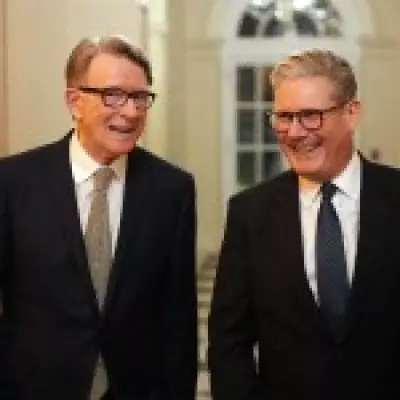
The House of Lords is poised for a historic constitutional shift as its longest-serving member, Lord David Trefgarne, prepares to depart after an astonishing 64-year tenure. The 84-year-old hereditary peer will be compelled to leave the upper chamber this spring when the Labour government's House of Lords (Hereditary Peers) Bill receives royal assent, marking the definitive end of a legislative tradition stretching back centuries.
The End of an 800-Year Era
Lord Trefgarne, the 2nd Baron Trefgarne, entered the Lords in June 1962 at the age of 21, automatically inheriting his title after his father's death. His departure symbolises the conclusion of what he describes as "the end of more than an era," a system with roots in the 13th century and the Magna Carta. While expressing sadness, he acknowledges the inevitability of the change. "I was coming to the end of my time in the house, anyway," Trefgarne stated. "I think it was inevitable eventually, and therefore I'm fairly relaxed about it."
The bill, expected to become law in April, will finally remove the remaining 92 hereditary peers who were allowed to stay following Tony Blair's 1999 reforms. Trefgarne was among those selected by fellow Conservatives to remain in the reduced rump. His 64-year service far surpasses that of any other current peer, making him a living archive of parliamentary history.

From Princeton Student to Thatcher Minister
Unlike ancient aristocratic lineages, the Trefgarne title dates only to 1947, when his father, George Garro-Jones, a Liberal-turned-Labour MP, was made a baron. The young David Trefgarne was studying at Princeton University in the United States when his father died. He admits to a slow start in his legislative duties, being "busy earning a living." This included a remarkable 1963 adventure flying a single-engined light plane from England to Australia and back in a 1930s biplane, followed by work as a commercial pilot.
His political career accelerated in his late thirties. He became a whip for Margaret Thatcher and held a series of ministerial roles throughout her governments. A pivotal moment came in 1982 as a junior Foreign Office minister, when he wound up a crucial Lords debate on the Falklands crisis after Foreign Secretary Lord Carrington resigned. Trefgarne recalls attempting, alongside Thatcher, to persuade Carrington to stay. "He kept saying: 'My honour demands nothing less.' He was, I think, the best foreign secretary since the war," he reflected.
Accepting the Inevitable Amid Personal Loss
While praising Thatcher and later Conservative leaders like David Cameron and Theresa May, he offered muted criticism of others: "I'm not a great Boris fan. What do I think of Liz Truss? Not a lot, to be honest." Despite not being a minister for 35 years, Trefgarne remained highly active on committees until 2022 and continues to vote and speak regularly, albeit less so after a "difficult year" following his wife's death.
His departure now seems accepted, though he previously resisted change. In 2016, he helped talk out a bill that would have phased out hereditary peers. His stance has now shifted in light of Labour's electoral mandate. "That was right at the time... But we are now in a position where the Labour party put their thoughts on the House of Lords in their manifesto, and they were elected with a large majority. So a change of some kind was inevitable," he conceded.
As he faces full retirement, when asked if he will miss the chamber, he offered a pragmatic, if wistful, reply: "Yes. But one's got to live in the real world." His exit closes a personal chapter spanning most of his life and a constitutional one spanning most of British history.