The political landscape of New York City, and by extension the United States, has been fundamentally reshaped by the improbable election of Zohran Mamdani as Mayor. This victory, achieved by a Ugandan-born Muslim progressive, has not only energised a base but also ripped open a growing fissure within the Democratic Party, playing out dramatically in the pages of the New York Post.
The Tabloid Frenzy: From 'Antifa' to 'Commie'
In the final month of the campaign, the New York Post embarked on a hysterical editorial crusade. It began with columnist Miranda Devine framing cities like Portland and Chicago as epicentres of an 'Antifa' takeover, dangerously endorsed by Democratic leaders. The narrative swiftly pivoted when the paper linked the insurgent candidate, Mamdani, to Imam Sirah Wahhaj, whom it labelled an 'unindicted co-conspirator' in the 1993 World Trade Center bombing.
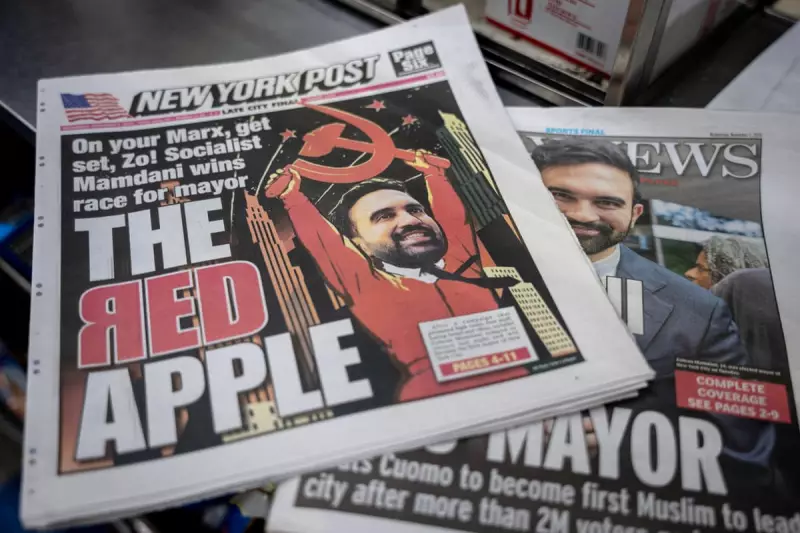
The paper's coverage then performed a remarkable ideological somersault. Before long, it had 'discovered' Mamdani's 'truer origins' not in jihadism, but in Marxism-Leninism. The special correspondent in Washington – former President Donald Trump – denounced the mayor-elect as a 'communist' who would bring 'Economic and Social Disaster'. Front pages screamed 'Keep the Commie Out!' and later, 'On your Marx, get set, Zo!'. The imagery was stark: a victorious Mamdani brandishing a hammer and sickle next to the headline 'THE RED APPLE'.

The Real Political Battle: Machine vs. Movement
Beyond the tabloid madness, a genuine and significant political struggle was underway. The Democratic Party machine, both nationally and in New York, mobilised to prevent this radical takeover of its essential machinery. Key figures like Senate Minority Leader Charles Schumer and House Minority Leader Hakeem Jeffries, who are also effective power brokers in Brooklyn, were notably tepid. Schumer offered no endorsement, while Jeffries gave a last-minute, unenthusiastic nod, likely to ward off a future primary challenge from Mamdani's camp.
Mamdani's success was rooted in popular policy. He pledged to freeze rents in an astronomically expensive city dominated by real estate interests, appealing directly to the city's struggling residents. This social democratic platform helped double voter turnout compared to 2021, to at least 42%, securing him a slim absolute majority with over 1 million votes. This surge in popular participation is precisely what party establishments fear, as it threatens top-down patronage and candidate selection.
The Maduro Incident and the Truce That Ended
The political education continued after the inauguration. Mamdani's short, unequivocal protest against the US-led capture and detention of deposed Venezuelan President Nicolás Maduro in Brooklyn contrasted sharply with the more muted criticism from Schumer and Jeffries. Mamdani revealed he had called President Trump directly to protest, an act that promptly ended his brief honeymoon with the Post.
The paper's front page returned to attack mode with the headline 'DO AS I CHE!', accusing Mamdani of siding with a dictator over celebrating Venezuelans. This episode highlighted the mayor's willingness to break from established party lines on foreign policy, further alienating the old guard.
The Crucial Fault Line: Brooklyn vs. Queens
The most important political fight to watch now is not simply Trump versus the Democratic establishment. It is Mamdani and Alexandria Ocasio-Cortez versus Schumer, Governor JB Pritzker, and Gavin Newsom – the party's progressive wing against its most powerful institutional leaders.
The crucial geographical fault line for this civil war runs through New York City itself. It separates the machine-dominated borough of Brooklyn – the home of Schumer and the lamentable former Mayor Eric Adams – from sections of Queens, where Mamdani moved in 2018 and built his winning coalition. The Brooklyn machine 'took it in the teeth' on 4 November, a result that signifies a potential shift in power away from professional political operators and towards a more activist, demand-driven base.

While the New York Post provides a window into the reactionary panic this shift induces, the real story is the substantive and escalating conflict within the Democratic Party. Mamdani's victory is not merely a local upset; it is a tremor along America's most crucial political faultline, with aftershocks destined to be felt from Queens to Washington D.C.