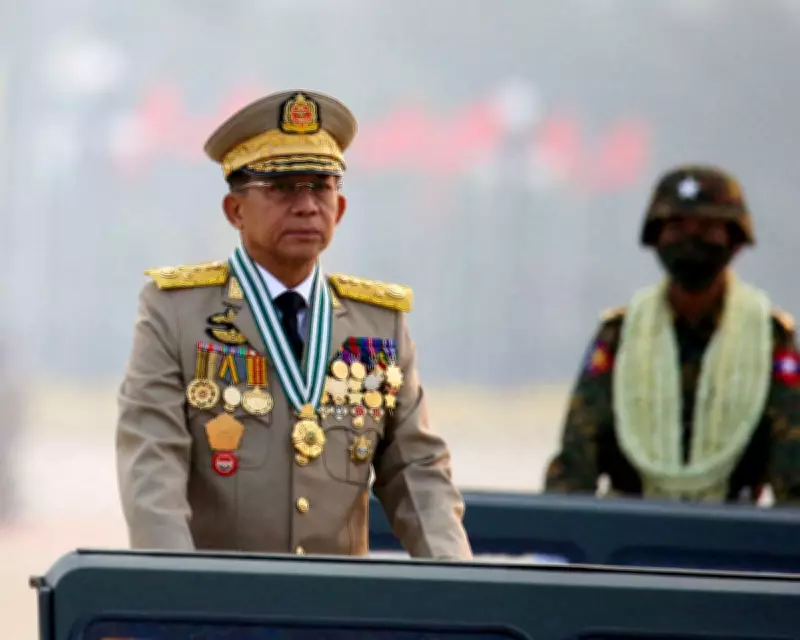
Myanmar's Junta Orchestrates Democratic Charade While Waging Brutal Civil War
Five years after seizing power in a violent coup, Myanmar's military leadership is preparing a carefully staged transition to a supposedly civilian administration. General Min Aung Hlaing, who has ruled the Southeast Asian nation since 2021, appears poised to exchange his military leadership for the presidency in what observers describe as a transparent attempt to cosplay democracy while maintaining absolute control.
A Conflict Overshadowed but Devastating
While global attention has focused on higher-profile conflicts, Myanmar's civil war has exacted a horrific toll. According to conflict-monitoring organization Acled, approximately 93,000 people have been killed since the military takeover. The United Nations reports that 3.6 million citizens have been displaced from their homes, creating one of the world's most severe humanitarian crises.
The junta's control over Myanmar remains tenuous at best, with significant portions of the country under opposition control. This territorial reality severely limited where recent elections could even be conducted. The main opposition forces refused to participate in what they denounced as sham elections, while ethnic minorities were systematically excluded from voting through citizenship denials.

Military Rejects Past Compromises
The current military leadership has concluded that previous experiments with hybrid governance were disastrous mistakes. The period when Aung San Suu Kyi's National League for Democracy was allowed to win elections and share power is now viewed by generals as a strategic error they are determined not to repeat.
Instead, the regime has escalated its campaign of terror against the population. Documented atrocities include bombing prisoners of war, systematic torture of political opponents, recruitment of child soldiers, and even the detention of toddlers. These brutal tactics have only strengthened the resolve of resistance forces fighting for genuine democracy.
International Complicity and Fractured Opposition
While China initially expressed displeasure with Myanmar's coup due to border instability and economic disruption, Beijing has increasingly thrown its weight behind the junta. Last year, pressure from China compelled the United Wa State Army to cut off essential support to other armed resistance groups. Many observers blame Chinese influence for the Myanmar National Democratic Alliance Army's decision to turn against former allies.
The opposition itself remains a fragile coalition of unlikely partners, including fighters aligned with the exiled National Unity Government, various ethnic armed organizations, and local resistance groups. These fractures have hampered coordinated action against the military regime.
Military Gains and International Failures
Recent battlefield successes have raised concerns that momentum may be shifting toward the junta. Russian expertise gained from the Ukraine conflict appears to be enhancing the military's drone warfare capabilities, leading to intensified attacks on civilian populations.
International response has been inadequate at best. While cases proceed at the International Criminal Court and International Court of Justice regarding persecution of the Rohingya minority, the broader civil war receives insufficient attention. Sanctions show some effect but require constant strengthening. The United Kingdom, once a leader in pressuring Myanmar's regime, has fallen behind, even denying study visas to Myanmar students seeking education abroad.
Genuine Democracy Emerges from Below
While generals stage their democratic theater in Naypyitaw, opposition-run local administrations are engaging in unprecedented democratic practices. These grassroots governments are consulting citizens on new constitutions, soliciting input on natural resource management, and discussing essential service provision—activities never before seen in Myanmar's political landscape.
Civilians exhausted by years of conflict nevertheless maintain their commitment to democratic ideals. The international community must not accept the junta's sham elections as justification for reduced pressure, nor ignore the ongoing struggle of Myanmar's people for genuine self-determination.