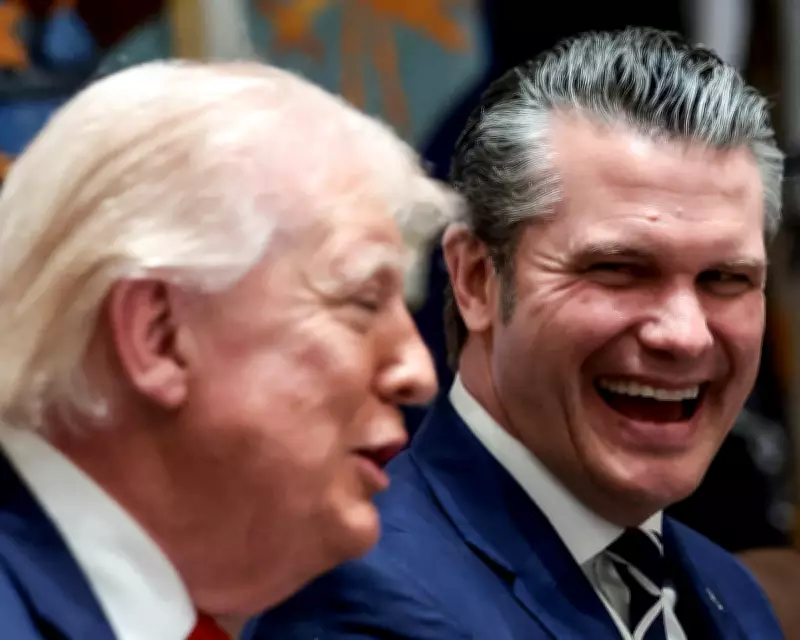
Trump's Unfiltered Language on Iran Conflict Breaks Political Norms
The Trump administration has embraced a strikingly brutal vocabulary when discussing military actions against Iran, marking a significant departure from the traditional political practice of using euphemistic language to describe warfare. This linguistic shift represents more than just rhetorical style—it reflects a calculated approach to communication that deliberately violates established social and political norms.
From Euphemism to Dysphemism: A Calculated Shift
On March 23, Donald Trump declared that if negotiations with Iran didn't proceed according to his preferences, the United States would "just keep bombing our little hearts out." A week later, the former president told journalists aboard Air Force One: "You never know with Iran because we negotiate with them and then we always have to blow them up." These statements exemplify a pattern of language that directly contradicts the careful, often sanitized terminology typically employed by political leaders when discussing military operations.
Pete Hegseth, a prominent figure within the Trump administration, demonstrated similar linguistic tendencies when he described with apparent pleasure the concept of "death and destruction from the sky all day long" on March 4. This approach stands in stark contrast to the subtle art of political euphemism that has characterized military discourse for decades.

The Historical Context of Military Terminology
The United States did not rename its Department of War to the Department of Defense until after World War II, reflecting a broader historical pattern of linguistic evolution in military terminology. Official names for military operations have traditionally employed carefully crafted language designed to shape public perception—from Operation Just Cause during the 1989 invasion of Panama to Operation Iraqi Freedom during the Gulf War.
Even the term "operation" itself functions as a euphemism, distancing military actions from their violent realities. Interestingly, despite his embrace of brutal language in other contexts, Trump himself avoided calling the conflict with Iran a "war," instead referring to it as an "excursion" or "our lovely 'stay' in Iran." This linguistic choice mirrors Vladimir Putin's description of Russia's actions in Ukraine as a "special military operation," highlighting how political leaders across different contexts employ language strategically.
The Psychology of Dysphemistic Language
The opposite of euphemism is dysphemism—language that makes something sound maximally horrible. While politicians traditionally reserve dysphemistic terms for their opponents, labeling them as "terrorists" or "fascists," the Trump administration has notably applied such language to its own actions. This represents a significant departure from conventional political communication strategies.
Hegseth explicitly stated on March 4: "This was never meant to be a fair fight, and it is not a fair fight. We are punching them while they're down, which is exactly how it should be." The following week, Trump posted on Truth Social about "these deranged scumbags" in Iran, adding: "I, as the 47th President of the United States of America, am killing them. What a great honor it is to do so!"
Violating Norms as Political Strategy
Sociolinguistic research indicates that the use of dysphemism deliberately violates social norms and taboos. Trump's administration has positioned itself as a taboo-breaking force, with this linguistic approach serving as a key component of its political identity. The apparent crudity of the language is not accidental but rather serves as a calculated political statement.
Hegseth in particular demonstrated what appeared to be sadistic pleasure in describing military actions, including his enjoyment of the idea of a "quiet death" for Iranian sailors during a torpedo attack. His frequent use of the term "lethality" and his declaration that "We are not defenders any more. We are warriors: trained to kill the enemy and break their will" further illustrate this linguistic approach.

The Paradox of Plain Speaking
This unabashed viciousness in language forms part of the appeal of the Trump administration for its supporters, potentially appearing as a refreshing return to plain speaking. However, as George Orwell noted, "The great enemy of clear language is insincerity." The brutal language employed by Trump and Hegseth may create an impression of honesty while potentially obscuring deeper strategic calculations and motivations.
When the focus shifts to destruction as a virtue in itself, questions about specific targets and casualties may become secondary. Hegseth described the goal as "unleashing" American "lethality" rather than "shackling" it, framing military power as a force that should operate according to its own instincts rather than strategic objectives.
Behind the Brutal Rhetoric
While the graphic language dominates public attention, other considerations may be receiving less scrutiny. The Financial Times reported that a broker acting for Hegseth sought to invest in U.S. military companies before the conflict with Iran escalated. Trump himself told the same publication: "My favourite thing is to take the oil in Iran."
Meanwhile, the White House website during Trump's administration presented a starkly different narrative, celebrating accomplishments in terms of "peace through strength" and positioning America as "an indispensable force for global stability." This contrast between public rhetoric and official messaging highlights the complex relationship between language and political strategy in contemporary governance.
The Trump administration's linguistic approach to discussing the Iran conflict represents more than just a stylistic choice—it reflects a deliberate strategy of norm violation and a particular vision of political communication. Whether this approach represents genuine transparency or a different form of political dissembling remains a subject of ongoing analysis and debate.