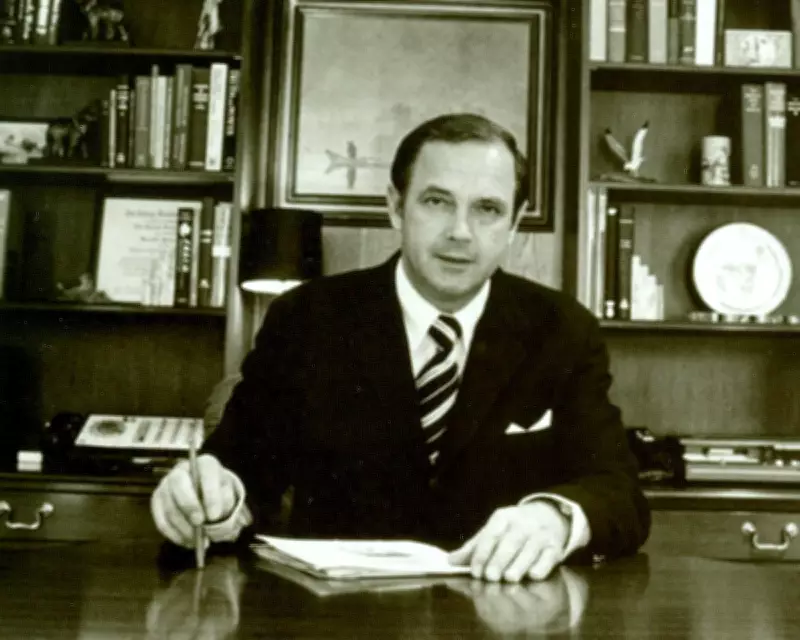
Alexander Butterfield, Nixon Aide Who Revealed Watergate Tapes, Dies at 99
The White House aide whose explosive revelation about Richard Nixon's secret recording system dramatically accelerated the Watergate scandal and ultimately contributed to the president's resignation has died. Alexander Butterfield, whose testimony before the Senate Select Committee on Presidential Campaign Activities in July 1973 exposed the existence of Oval Office tapes, passed away at the age of 99.
His death was confirmed to the Associated Press by both his wife, Kim, and John Dean, the former White House counsel who played a pivotal role in exposing the Watergate wrongdoing. Dean praised Butterfield for his courageous honesty, stating: "He had the heavy responsibility of revealing something he was sworn to secrecy on, which is the installation of the Nixon taping system. He stood up and told the truth."
The Secret Taping System
As a deputy assistant to President Nixon from 1969 to 1973, Butterfield oversaw a sophisticated voice-activated taping system that had been secretly installed in four key locations:

- The Oval Office
- The Cabinet Room
- Nixon's office in the Executive Office Building
- The presidential retreat at Camp David
Butterfield later revealed that, aside from himself and President Nixon, only a handful of individuals knew about the extensive recording operation, including White House chief of staff HR Haldeman, one of Haldeman's assistants, and several Secret Service agents. "Everything was taped ... as long as the president was in attendance," Butterfield testified under oath during his preliminary interview with Watergate investigators.
The Explosive Revelation
By July 1973, Butterfield had left the White House to become administrator of the Federal Aviation Administration when Senate committee staffers privately questioned him about the possibility of a taping system. The inquiry had been prompted by John Dean's earlier testimony suggesting his conversations with Nixon might have been recorded.
When Butterfield confirmed the system's existence, he was immediately brought before a public hearing of the Senate Select Committee on Presidential Campaign Activities. His public revelation on July 16, 1973, stunned both Nixon's supporters and opponents alike, providing Watergate investigators with what would become the most crucial evidence in their investigation.
The tapes would eventually expose Nixon's direct involvement in the cover-up following the 1972 burglary at Democratic party headquarters in the Watergate building. After a yearlong legal battle that reached the Supreme Court, Nixon was ordered to surrender the tapes in July 1974. Less than a month later, facing certain impeachment by the House of Representatives, Nixon resigned on August 9, 1974.
Butterfield's Reflections and Legacy
In a 2008 oral history for the Nixon Presidential Library and Museum, Butterfield reflected on his role in the president's downfall: "I didn't like to be the cause of that, but I felt that I was, in a lot of ways." He added: "I just thought, 'When they hear those tapes ...' I mean, I knew what was on these tapes ... they're dynamite."
The thousands of hours of tapes, now controlled by the National Archives, provided an unprecedented and often unflattering view of Nixon's presidency, revealing his temper, vulgar language, prejudiced views, and candid opinions about national and international figures.
Butterfield believed that his testimony led to his dismissal as FAA administrator in 1975, telling friends he had been targeted shortly after his Senate committee appearance. Following his government service, he worked as a business executive in California and earned a master's degree from the University of California, San Diego, in 1994.
In his later years, Butterfield became increasingly critical of his former boss, describing Nixon as "not an honest man" and "a crook." He believed Nixon had prior knowledge of the Watergate break-in and masterminded the subsequent cover-up. Reflecting on Nixon's resignation, Butterfield told the Nixon Library: "I found myself cheering ... just cheering because justice had prevailed. I didn't think that it would for a while. This guy was the ringleader."

Butterfield's disclosure of the taping system remains one of the most consequential moments in American political history, fundamentally altering the course of the Watergate investigation and contributing to the first resignation of a U.S. president. His testimony demonstrated the power of truth-telling in the face of presidential secrecy and corruption.