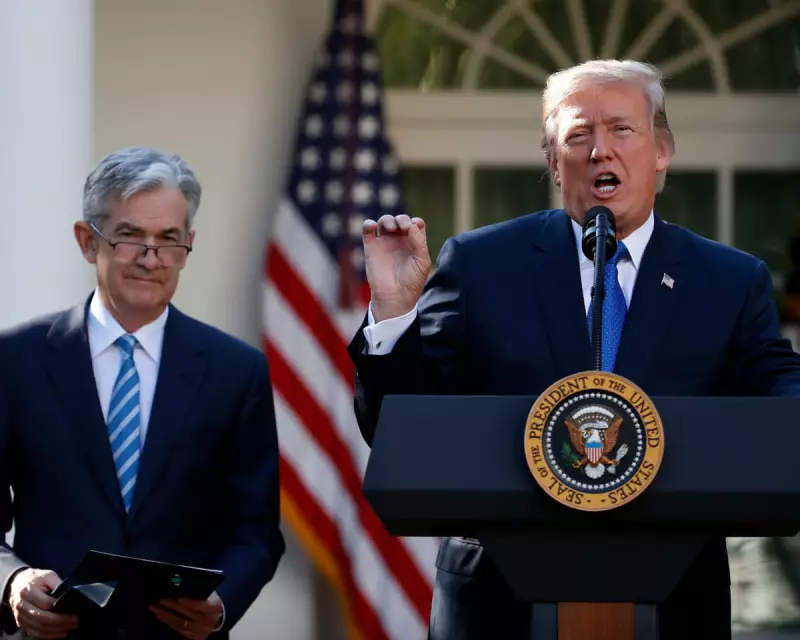
The news that Donald Trump's Justice Department has opened a criminal investigation into Jerome Powell, the Chair of the Federal Reserve, represents far more than a personal vendetta. It is the latest and most brazen manifestation of the President's governing creed: submit to his will, or face destruction. This move against the nation's top banker sends a chilling message to any person or institution that believes their authority exists independently of the Oval Office.
A Test of Institutional Independence
The investigation centres on allegations that Powell lied to Congress in testimony regarding renovations to the Federal Reserve building—a familiar charge reminiscent of the pretext used against former FBI Director James Comey. Powell's real 'crime', however, is widely seen as his refusal to bow to presidential pressure. President Trump has repeatedly attacked and threatened to fire Powell for not cutting interest rates aggressively to stimulate the economy.
Powell has framed the threat accurately, stating it is a direct consequence of the Fed setting policy based on public interest, not presidential preference. His stance has been backed by an extraordinary coalition of former Fed chairs—Janet Yellen, Ben Bernanke, and Alan Greenspan—who condemned the probe as an "unprecedented" assault on central bank independence, akin to practices in "emerging markets with weak institutions." Even Republican Senator Thom Tillis, a member of the Senate Banking Committee, called the Justice Department's actions a "huge mistake."

The Real Audience: The Supreme Court and the Rule of Law
While destabilising to financial markets, the investigation's purpose extends beyond economics or Powell's fate, as his term expires in May 2025. The primary audience for this spectacle is the United States Supreme Court. The timing is conspicuous, coinciding with pending rulings on presidential powers over tariffs and the oral arguments in the case of Fed board member Lisa Cook, whom Trump is seeking to remove for alleged mortgage fraud.
The administration's argument in the Cook case is particularly revealing. It contends that the President's right to fire an official "for cause" is beyond judicial review, asserting that "courts may not review his factual findings or his application of the for-cause standard." This establishes a dangerous precedent: no one, not even the judiciary, should second-guess Donald Trump's judgment.
A Blueprint for One-Man Rule
This episode underscores a fundamental truth about Trump's ambitions: he seeks not partial victories but total control. The 90% success rate he enjoys at the Supreme Court is insufficient. The investigation of Powell demonstrates a new tactic—using a weaponised Justice Department to intimidate and punish perceived obstacles.
This strategy directly challenges the Court's own subtle protections for the Fed. In a recent ruling, the Court suggested its broad approval of presidential removal powers might not apply to the "uniquely structured" Federal Reserve, highlighting its historical insulation from political control. Such legal distinctions mean nothing to a President who "cannot tolerate any system where he does not have total control," as commentator Andrew Sullivan observed.
The message is brutally clear: resist, and you will be ruined. By targeting Jerome Powell, the Trump administration is warning Supreme Court Justices, and indeed every independent actor, that they too could be in the crosshairs. In the face of this concerted effort to end the American republic's system of checks and balances, it is more critical than ever for the Court and the public to demonstrate they will not capitulate.