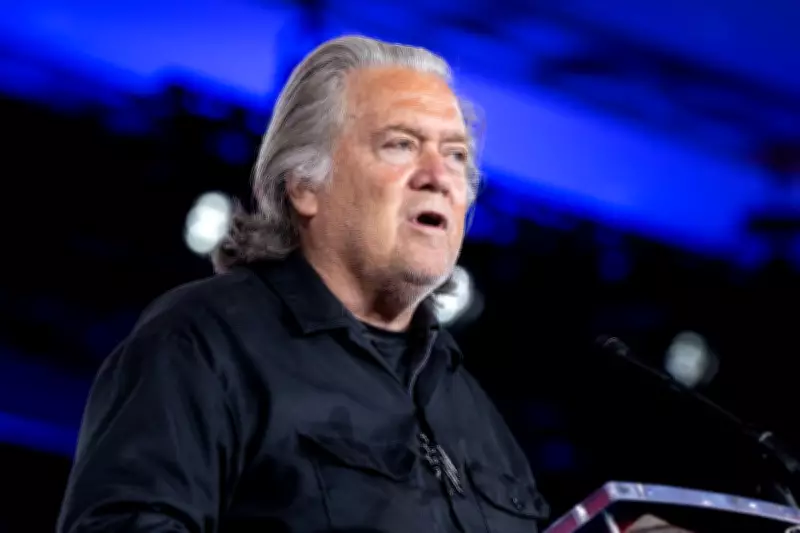
Supreme Court Orders Review of Steve Bannon's Contempt Conviction
The United States Supreme Court has taken a significant step that could lead to the dismissal of Steve Bannon's criminal conviction for contempt of Congress. In a brief order filed on Monday, the high court vacated a lower court ruling that had previously upheld the rightwing media host's conviction.
Case Returned for Dismissal Consideration
The Supreme Court's order sends the case back to the US Court of Appeals for the DC Circuit for what the court described as "further consideration in light of the pending motion to dismiss the indictment." This development comes after the Trump administration formally moved to dismiss Bannon's conviction, marking a pivotal moment in the legal proceedings against the former Trump strategist.
Steve Bannon, who served as chief strategist in the first Trump administration for less than a year before becoming a prominent voice in the "Make America great again" movement through his War Room podcast, was convicted by a DC federal court jury in 2022. The conviction stemmed from two misdemeanor counts of contempt of Congress for his refusal to comply with a subpoena to testify before the House committee investigating the January 6 insurrection.

Legal Arguments and Previous Proceedings
Bannon's legal team has consistently argued that their client was following attorneys' advice when he declined to testify before Congress. In their Supreme Court filing, Bannon's attorneys raised significant questions about separation of powers and how executive privilege should apply to congressional subpoenas, despite Bannon not being part of the Trump administration during the 2021 Capitol riot.
The attorneys also challenged the court's interpretation of "willfully" not complying with the subpoena as being equivalent to "intentionally" refusing. "Fundamental separation of powers principles – which are essential to our constitutional framework – lead to one path forward," Bannon's legal team wrote in their Supreme Court submission.
Following his initial conviction, an appeals court upheld the ruling, resulting in Bannon serving four months in prison during 2024. The Trump administration's intervention in the case represents a dramatic turn, with government attorneys stating in their Supreme Court filing: "The government has determined in its prosecutorial discretion that dismissal of this criminal case is in the interests of justice."
Symbolic Victory and Additional Legal Matters
Since Bannon has already completed his prison sentence, overturning the conviction would represent primarily a symbolic victory. However, the legal implications extend beyond symbolism, potentially setting precedents for how congressional subpoenas are enforced against former administration officials.
This contempt of Congress case represents just one chapter in Bannon's legal challenges. The media host previously pleaded guilty to fraud charges in New York state court related to a campaign to finance and construct a border wall. Those federal charges were pardoned by former President Donald Trump, though state charges remained unaffected by the presidential pardon.
The Supreme Court's action does not guarantee dismissal but creates a clear pathway for the appeals court to reconsider the case with specific attention to the dismissal motion. Legal observers note this development reflects ongoing tensions between congressional oversight authority and executive branch prerogatives, particularly concerning investigations into the January 6 Capitol attack.