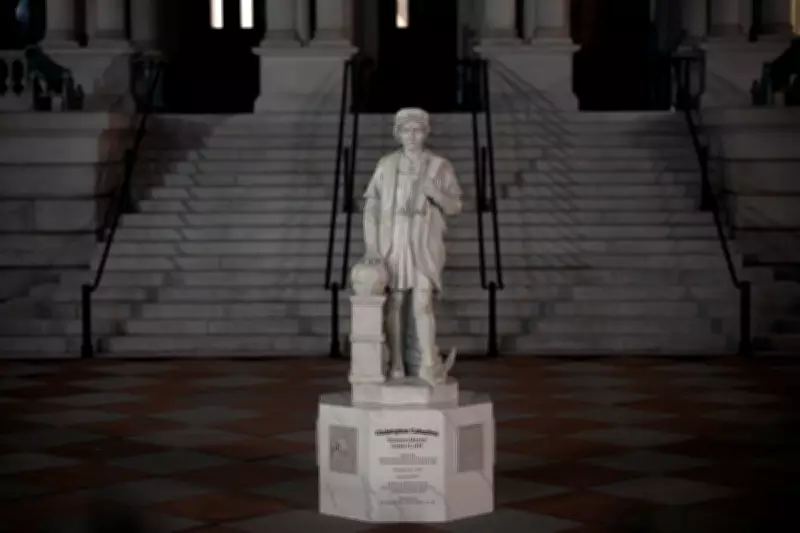
A newly reconstructed statue of Christopher Columbus has been prominently installed on the grounds of the White House, a move orchestrated by former President Donald Trump that has reignited longstanding debates over the explorer's complex historical legacy. The thirteen-foot tall, one-ton monument now stands outside the Eisenhower Executive Office Building adjacent to the White House on Pennsylvania Avenue, serving as a symbolic gesture by Trump to position Columbus as a foundational American hero.
From Harbor Depths to Presidential Grounds
The current statue represents a remarkable resurrection story. It was meticulously reconstructed in 2022 using shattered fragments retrieved from Baltimore's inner harbor, where the original monument had been torn down and discarded during widespread anti-racism protests in July 2020. The pedestal bears inscriptions that chronicle this journey: "Destroyed July 4, 2020 ... Resurrected 2022 ... Rededicated by President Donald J. Trump, October 13, 2025."
Trump's Personal Involvement and Rhetoric
Trump personally championed the statue's placement, writing in a letter to Basil Russo, leader of the Conference of Presidents of Major Italian American Organizations, that Columbus "was the original American hero and one of the most gallant and visionary men to ever walk the face of the Earth." The organization owns the statue and has loaned it to the federal government for display. Trump expressed being "truly honored that this magnificent statue will now sit on the grounds of the White House," while the White House social media accounts amplified this message, declaring Columbus a "hero" whose legacy Trump would ensure is "honored as such for generations to come."

The Controversial Legacy of Columbus
Christopher Columbus occupies a deeply contested space in American historical consciousness. While traditionally hailed as the discoverer of America, historical records show he never actually set foot on the continental United States, arriving instead in what is now the Bahamas during his voyages between 1492 and 1504. More critically, Columbus's legacy is marred by his documented role as a slave trader and his involvement in the subjugation and killing of Indigenous peoples throughout the Caribbean region.
Shifting National Perspectives
In recent years, honors bestowed upon Columbus have faced increasing scrutiny across the United States. Numerous jurisdictions have replaced Columbus Day with Indigenous Peoples Day, reflecting a broader reassessment of historical figures and their impacts. Former President Joe Biden, in his 2021 Columbus Day proclamation, acknowledged that the explorer "ushered in a wave of devastation: violence perpetrated against native communities, displacement and theft of tribal homelands, the introduction and spread of disease, and more."
Enduring Symbolism and Divergent Views
Despite these controversies, Columbus's legacy continues to hold significant cultural weight. The District of Columbia itself bears his name, and many Italian-American organizations maintain deep reverence for the Genoese explorer as a symbol of national pride and cultural heritage. The newly installed statue thus represents not merely a physical monument but a focal point for ongoing national conversations about historical memory, cultural identity, and how societies choose to commemorate complex figures from their past.
The placement of this reconstructed Columbus statue on White House grounds during Trump's administration underscores the continuing political dimensions of historical commemoration, ensuring that debates about America's foundational narratives will remain prominently visible at the nation's most symbolic address for the foreseeable future.