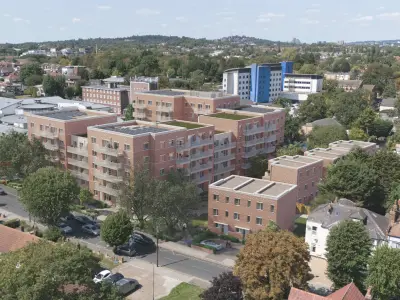
A new report from Create Streets warns that City Hall must learn from the failures of Croydon's small-site redevelopment experiment when addressing London's housing crisis. Between 2019 and 2021, Croydon implemented a Suburban Design Guide that made it easier to demolish two-storey homes and replace them with three-storey blocks, adding a net 520 homes per year. However, the policy sparked voter fury over lost local character, leading to the Labour mayor being ousted in 2022.
Successful alternatives: Chelsea, Tower Hamlets, and Haringey
The report highlights three areas where clear design rules enabled homebuilding without political backlash. In Haringey, a 2010 policy allowing Victorian terraced houses to add up to 1.5 storeys under a strict design code saw more than a fifth of 1,000 eligible properties take up the change. Mayor Sadiq Khan praised the approach in 2022, saying it supports 'predictable, replicable, and high design quality' development.
In Tower Hamlets, guidance on mansard roofs introduced in 2023 led to a nearly sevenfold increase in applications, a success rate rise from 27% to 93%, and 300 additional bedrooms. The report notes: 'Again, a strict design code was used insisting that new mansards ‘fitted in’. There has been no notable political resistance and the policy remains in place.'

Chelsea's Local Development Order
In Chelsea, a Local Development Order (LDO) applied to 12 homes on Redcliffe Road in 2024 allowed mansard construction within a set framework. Half of the homes have already started construction. The report's author, Nicholas Boys Smith, said: 'In each of these cases, the crucial difference to Croydon was not simply that more development was allowed, but that it was allowed within a tight visual code that made the uplift legible, repeatable and locally acceptable.'
Mayoral Development Orders as a tool
The report suggests using Mayoral Development Orders (MDOs), similar to those used by Khan on Oxford Street, to 'help London move from case-by-case discretion towards clearer, rules-based permission.' The recently passed English Devolution and Community Empowerment Bill drops the requirement for local authorities to approve MDOs, making them a more powerful tool for the Greater London Authority (GLA). However, secondary legislation is needed to ensure MDOs become a London-wide analogue to LDOs.
Expert and public opinion
Nicholas Boys Smith said: 'The lesson from Croydon is not that people oppose housebuilding. They don't. People oppose ugly developments which scar their sense of home. The public are perfectly willing to support gentle density and new homes when they are attractive, predictable, and fit into the street they already know and love.'
Maurice Lange, an analyst for Centre for Cities, told the Local Democracy Reporting Service (LDRS) that the GLA should implement successful elements of the Croydon model in the next London Plan. 'There is no way London will hit their 88,000 targets without building on both large and small sites,' he added.
Mayor's response
A spokesperson for the Mayor of London told the LDRS: 'The Mayor is determined to do everything possible to increase housing delivery across London, including making the most of brownfield land, small sites and regeneration opportunities in the right places. The draft London Plan is being published soon and will set out a long-term, evidence-based framework for how London can meet its housing need while supporting jobs, infrastructure and sustainable growth.'