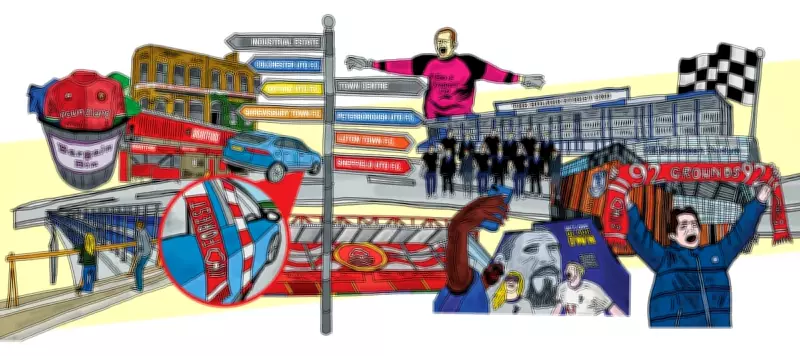
A 43-Year Football Odyssey: How the Beautiful Game Transformed Across England
It was destined to conclude exactly like this: a long and arduous journey that began in 1982 on a crumbling terrace culminated on a grey, drizzly December afternoon watching my team suffer a 3-0 defeat in a brand new stadium named after an international commercial law firm. A glorious last-minute away victory would have felt too poetic. This was the authentic, unvarnished reality when I finally completed visiting all 92 English football league grounds.
The Changing Face of Football Fandom
Most matches were attended as an away Nottingham Forest supporter, while others were watched as a neutral observer. This ludicrous yet wholly fulfilling enterprise taught me countless lessons about football's evolution. Where fans once displayed allegiances by carefully trapping scarves in car windows to flutter proudly during journeys, today we see executive car stickers and personalized number plates instead. Our society feels diminished by this subtle shift in how we express our passions.
These days, visiting a ground within walking distance of a town center has become a rare delight that feels like a proper day out. More significantly, such locations encourage a genuine sense of place. You know exactly where you are and feel connected to your surroundings, something utterly absent when navigating industrial estates on ring roads or science parks. Apologies of a kind to Colchester, Oxford, and Shrewsbury for their remote locations, with appreciation to Luton, Peterborough, and Sheffield United for maintaining their central positions.

The Disappearing Matchday Pub
We all remember Griffin Park with its famed pub on each corner, but by the ground's final days, not all remained open for business. Pubs nearest football grounds have been closing at an alarming rate nationwide. Meanwhile, clubs have grown increasingly preoccupied with maximizing footfall and revenue streams. Their solution? Encourage fans to purchase beer inside stadiums instead. Thus, modern arenas incorporate bars directly into fancy new stands. Some prove surprisingly good, particularly when no pubs exist within walking distance.
The Return of Standing Terraces
You can still find traditional terraces behind goals at many grounds. Higher up the leagues, safe standing has become commonplace, raising the obvious question: why was this so difficult to implement initially? The transition from safe standing seeming fantastical to becoming ubiquitous happened remarkably quickly. Football fans have demonstrated they can enjoy nice things without breaking them, contrary to long-held assumptions.
How wonderful to visit new grounds and mentally recreate famous goals witnessed on television. That goalmouth is where Jimmy Glass scored to preserve Carlisle United's league status. Virtual blue plaques should commemorate such moments. Similarly, there's delight in losing track of the game while Googling Percy Ronson of Fleetwood or Eric Whalley of Accrington to discover why they're revered enough to have stands or bars named in their honor.
The Ultra Culture Phenomenon
For years, English fans envied German supporters for their flag-waving, constant chanting, and strong sense of identity. Rather than adapting the best elements to their own clubs, some supporters have simply copied the aesthetic wholesale. While anything enhancing atmosphere deserves welcome, the practice of wearing uniforms—invariably all-black clothing—to assert fandom seems peculiar. This carries a whiff of superiority, suggesting only those wearing specific attire qualify as "proper" fans.
Most clubs now boast their own baby ultra squads. Barrow's group proves particularly visible when their team scores at the Holker Street End and they surge toward away fans. By all means, wave flags and sing songs passionately, but is uniform clothing truly necessary?
The Flag Revolution
Large flags have become ubiquitous across English football. Clubs even employ official flag wavers. The spectacle looks magnificent when a huge flag surfs from one end of a stand to another while smaller flags wave throughout other sections. Like safe standing, why were supporters told for decades that flags weren't welcome? They were actively discouraged, with eager stewards pouncing on anyone daring to wave one.

Actually, bringing such flags into games without prior permission remains challenging. Clubs appear to want the visual spectacle while maintaining control, making flag-waving official as if supporters cannot be trusted to wave them correctly. Regardless, more big flags should be encouraged—just let fans organize themselves.
Matchday Traditions and Discoveries
Bargain bins in club shops toward season's end hold hidden treasures. You can discover unusual memorabilia, and it's the perfect time to purchase shirts as clubs redirect attention toward new kits. Kudos to Walsall for selling theirs for as little as ten pounds, with extra credit for featuring Poundland emblazoned across the front.
Regarding sponsors, one way to alleviate tedious matches involves studying advertising hoardings. Speculate about what Betterwave at Accrington actually does, ponder D Catchesides Roofing's reliability in the Bromley area, or contemplate the huge Britcon hoarding at Scunthorpe that raises numerous contemporary political and social questions. Scan any stadium thoroughly—especially in the northwest—and you're never far from a Rainham Steel advertisement.
New Traditions Emerge
Organized fireworks displays have become events in lower leagues. Who realized they were so heavily advertised or even existed? Such promotions appear more frequently than Elton John concert announcements at provincial grounds. Like ultra culture, flag-waving, and safe standing, murals around grounds have finally entered football's mainstream, making traditional walks around new stadiums genuinely enticing. You might actively seek out murals seen online, creating local identity in warm, inviting ways that say "come see our heroes" rather than threatening exclusion.
Enduring Constants
Despite all changes, constants remain across those 43 years. In late autumn, you enter grounds in hazy sunshine and exit into dark, wintry blackness. This transition makes you feel you've accomplished something meaningful with your Saturday. When colleagues inevitably ask "do anything nice at the weekend?" on Monday morning, you can answer definitively: yes, yes I certainly did.