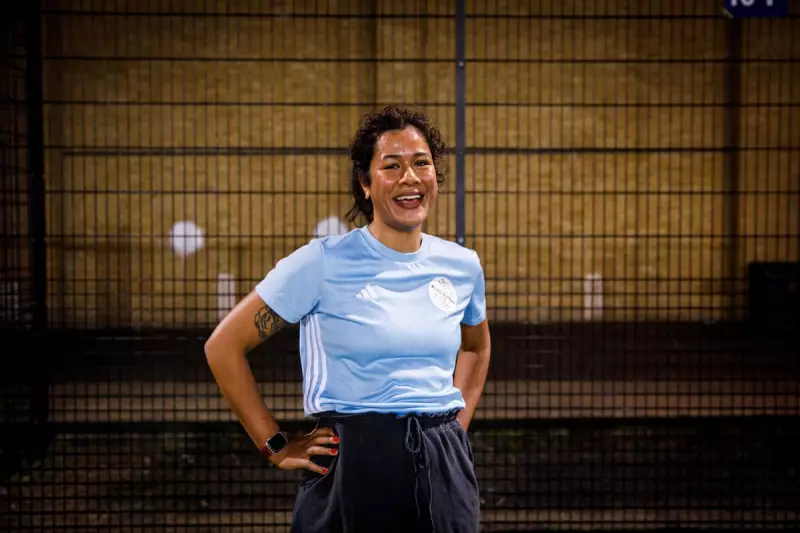
For fifteen years, Poppy Noor has loved playing football, yet describes her own ability with brutal honesty: she possesses "three left feet" and a shot that lacks conviction. Despite her long-term devotion to the sport, core skills like tackling and shooting have stubbornly refused to improve. Now in her mid-30s and a mother of two, she embarked on an experiment: could someone seemingly "cosmically ungifted" at football actually get better with professional help?
The Burden of Low Expectations
Noor's relationship with football is rooted in a different era for the women's game. Growing up in the 1990s, when there were only about 80 girls' clubs in England (compared to over 12,000 today), she recalls being kicked off pitches by boys. This context fostered a mindset where simply being allowed to play felt like a blessing, overshadowing any desire for technical excellence. For years, she played in defence, viewing it as a less technical position where she could rely on reaction rather than skill, treating the sport "like an uninterested lover" to avoid the disappointment of trying and failing.
However, the cycle of starting beginner teams only to be overtaken by total novices became depressing. Determined to break it, she enlisted the help of coach Wayne Phillips, known for his work with women's teams. His initial assessment was frank: "It's going to be a battle."

Deconstructing the Game and the Self
Phillips broke down football ability into four pillars: physicality, technical skill, social attributes (like teamwork), and psychology. They agreed on a strict regimen of weekly one-on-one sessions, group training, and matches, with Noor committing to extra fitness work.
The early sessions were humbling. Drills on dribbling, Cruyff turns, and step-overs ended in failure, leading Noor to believe the training was pitched too high. But Phillips identified a deeper issue: Noor had painted herself into a tactical corner. She only received the ball in a basic, square-on stance, limiting her options. The real training began not with fancy tricks, but with learning to create angles, receive the ball on her back foot, and make reverse passes.
The Painful Process of 'Reinvention'
Progress was not linear. After a month, Noor felt she was getting worse, making rookie errors in matches and struggling with fundamentals during drills. Phillips framed this as an inevitable part of reinvention. He also pinpointed a critical barrier: her negative self-talk. "The way you talk to yourself, it's invasive," he told her. "All of this 'I'm rubbish' stuff? Just leave it at the door."
A breakthrough came via an analogy from a friend about a trumpet player relearning their "embouchure" (mouth position) to go pro. Noor realised that in focusing on new attacking concepts, she had neglected basics like cushioning a pass or keeping her head over the ball. Once she recognised this problem, her game improved. She scored from a header, began chaining skills together, and even contemplated becoming a striker.
Coach Phillips, who initially wondered "how am I going to deal with this," noted proudly that her actions were now "clean." He reframed her dedication—running on lunch breaks, doing yoga—not as overcompensation but as serious commitment to her goals.
The Final Whistle: A New Mindset
The journey culminated with Phillips watching Noor play a fast-paced, mixed five-a-side match. While the game itself was brutal against towering opponents, the walk off the pitch felt different. The measurable outcome wasn't about becoming the best player, but about proving to herself that improvement was possible. She had set a goal to get better in her mid-30s, amidst the demands of motherhood and work, and had seen it through. The victory was in the effort itself, a feeling of accomplishment that made every struggle worthwhile.