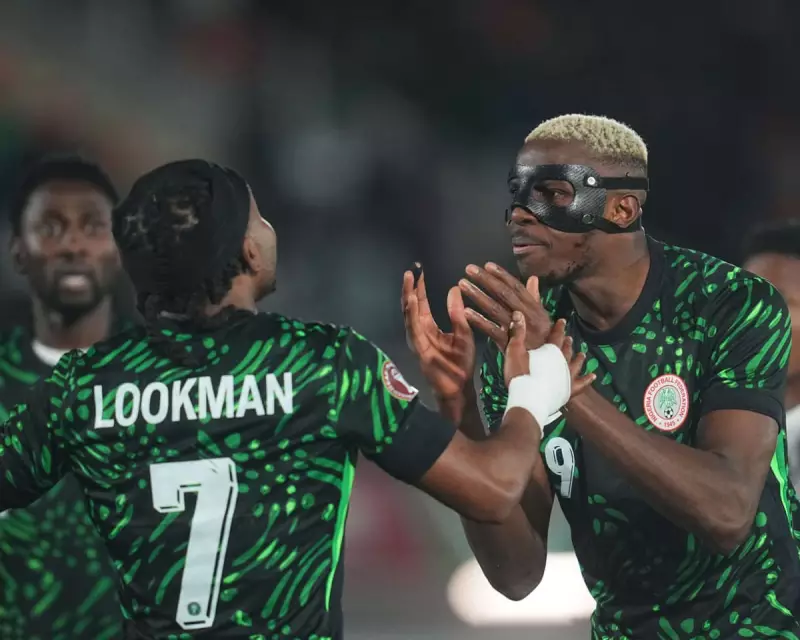
Nigeria's star striker Victor Osimhen finds himself at the centre of controversy yet again, as his on-pitch argument with teammate Ademola Lookman threatens to destabilise the Super Eagles' Africa Cup of Nations quest. The incident occurred during Monday's 4-0 victory over Mozambique, overshadowing Osimhen's own two-goal performance and shifting focus to his combustible behaviour ahead of a crucial quarter-final against Algeria this Saturday.
A Volatile Talent Under the Microscope
The 27-year-old Napoli forward, Nigeria's talisman and top scorer in the tournament with three goals, publicly remonstrated with Lookman during the match. His frustration reportedly stemmed from what he perceived as selfish play from the winger, which he believed cost the team several scoring opportunities. This latest outburst is not an isolated incident but part of a pattern of volatile behaviour that has repeatedly placed Osimhen in the headlines for the wrong reasons.
Those familiar with Osimhen's social media presence will recognise the self-described "coconut head" – a Nigerian term for an obstinate person who speaks their mind regardless of consequence. This temperament first drew major public attention in 2022, when he clashed with former Nigeria striker and 1994 Afcon winner Victor Ikpeba. Ikpeba, working as a pundit, had criticised Osimhen's decision-making during a World Cup playoff against Ghana. Osimhen's retaliatory Instagram post, labelling Ikpeba "Pundit Isonu" (meaning "useless" in Yoruba), was widely condemned as disrespectful.

A History of Confrontation
The pattern continued into 2024 with a more serious spat involving then-head coach Finidi George. Osimhen launched a vitriolic live Instagram broadcast, incensed by an alleged statement from George questioning his commitment to World Cup qualifiers. The broadcast grew so heated that former striker Odion Ighalo, a mentor to Osimhen, intervened to shut it down. Finidi George later denied making the comments that sparked the fury, expressing disappointment that Osimhen never apologised.
Nigeria's current coach, Éric Chelle, now faces the delicate task of managing his star player's emotions in the high-pressure environment of the Afcon knockout stages. Chelle has stated firmly that the Lookman incident will be handled internally, telling reporters: "This is a question of my management. What happened on the pitch will stay in the group."
The Quest for Glory Amidst Turmoil
Despite the distractions, Osimhen's burning desire to win the Afcon trophy for Nigeria is undeniable. After falling short in the 2024 final against hosts Côte d’Ivoire, he has repeatedly stated his ambition to deliver the continent's most prestigious prize to Nigerian fans. His motivation is deeply personal, driven by a childhood spent selling water on the streets of Lagos to help his family escape poverty. "Getting my family out of poverty is my biggest win," he has said, framing football as his route to a better life.
Former Nigeria assistant coach Emmanuel Amuneke, who has worked closely with both Osimhen and Lookman, advocates for a calm resolution. "Osimhen is one with a lot of character," Amuneke told the Guardian. "It's not that he is a bad person. He has the character of a person that wants to win. We need different characters in our team in order to succeed."
As Nigeria prepares for their quarter-final in Marrakech, the team's success hinges on more than Osimhen's undeniable prowess as the first African to be Serie A's capocannoniere (top scorer). It also depends on his ability to channel his fierce determination positively, ensuring his talent is not eclipsed by his temperament. For the Super Eagles to lift the trophy, they need their talisman to be a unifying force, not a disruptive one.