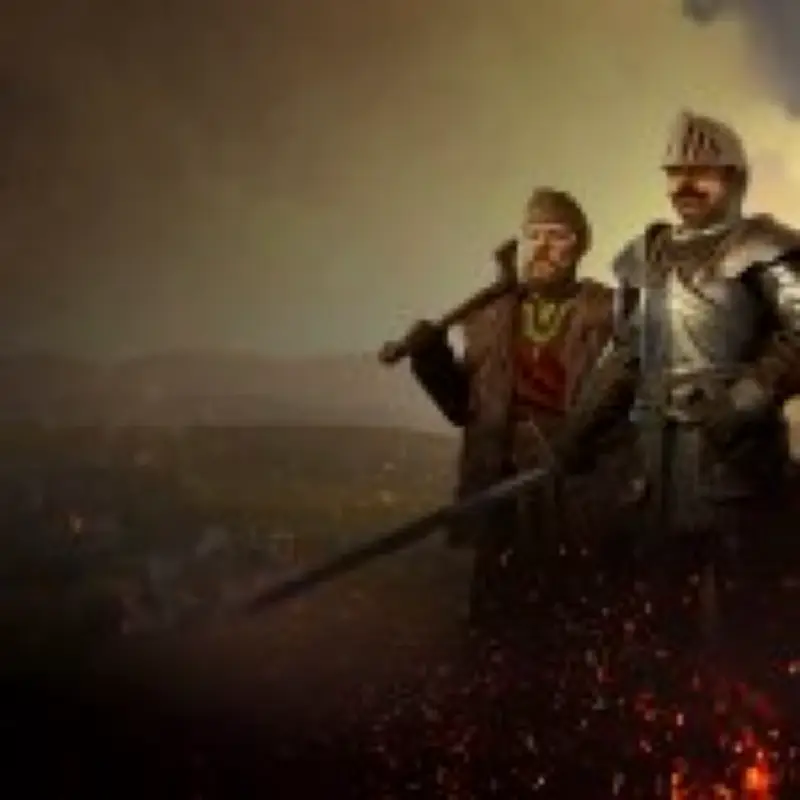
Kingdom Come: Deliverance may have cornered the market on historical role-players but this new indie game takes a more strategic approach to a similar concept. While there are countless games based on Tolkien's vision of the Middle Ages, blending people living in primitive conditions with magic, fantastical beasts, and mythical evils, there's another breed of role-playing game that ignores fantasy in favour of a more realistic and nuanced simulation. Kingdom Come: Deliverance is the most obvious example of that brand of historically authentic first person role-playing. Another is Bellwright, which has just launched on PlayStation 5 and Xbox Series X/S after a successful spell in early access on PC.
It shares much in common with Deliverance, from its emphasis on unvarnished realism to its Central European setting and historical time period, but it's in the areas where they differ that Bellwright really gets interesting. While both cast you as an initially lowly peasant who has to work your way up from ragged insignificance, where Kingdom Come is all about you as an individual, Bellwright is a management game at heart. Not that you won't be fully involved in absolutely everything, from the mechanics of survival in a harsh winter to battles with brigands, wolves, and soldiers loyal to a corrupt monarch, but thriving in those scenarios is about far more than just forging stronger weapons and armour.
Team Effort from the Start
In Bellwright, success is a team effort, but at the beginning of the game that team is just you and a grumpy hunter who's been cast out by the local village elder. Finding yourselves alone in a fairly hostile wilderness, you decide to pool your efforts and resources, building an encampment out of materials you scavenge from nature. Where plenty of games have you looting resources for construction, few match Bellwright's dedication to accuracy, which has you adding each individual branch to your emerging building, assembling the wooden frame piece by piece, before finishing it with a covering of foliage.

You're immediately encouraged to assign tasks to your new friend, who can be deployed as anything from labourer to mercenary: finding materials, bringing them to the site, and using them to build your camp, mining ore, or acting as a lumberjack. You can also set him to work at the research table, expanding your mastery of its medieval tech tree, a process that improves your ability to survive and fight, as well as letting you build more advanced structures.
Exploration and Strategy
That's also enabled by the living countryside around you. As you explore, the map automatically records the locations of useful building materials, bandit camps, and natural features. Bellwright is admirably short of mollycoddling, letting you work things out for yourself, wherever it makes sense. That includes where to strike camp in the first place, a decision that turns out to have innumerable ramifications. The first of those is proximity to resources. If your assembly lines are close to trees, water, and seams of ore to quarry, you're in good shape, but you also have to consider the territory of local packs of wolves and the location of brigand encampments. Initially, before you've researched and assembled serviceable weapons and armour, meeting either of those groups is instantly lethal, and ensuring your opening hours are spent without running into either one is essential to survival.
As your settlement grows, you'll increasingly need to gain additional expertise. It's simply not feasible to become expert in everything, which means you'll need to recruit specialists in everything from forestry and farming to combat. To do that you need to liberate villages by gradually growing your reputation with them, partly through trading with their elders and partly through completing side quests for locals. Once freed, you'll have your pick of recruits from the population and that's where you can really start laying down useful tradesmen for your operation. This is also key to the overarching story, which has you fomenting a rebellion against a monarch whose cruelty and murderous intentions have all the local villages on edge. Becoming powerful enough to do that forms the meat of the game.

Combat and Management
Outside combat, you can staff different facilities, as well as assigning them a level of priority, which governs the order in which your minions undertake the many jobs available. Tinkering with those settings to make sure you enjoy a steady flow of necessary resources, alongside feeding everyone and gradually unlocking the tech tree, will also occasionally be interrupted by raiding parties sent from local bandit camps. It helps keep you on your toes and ensures you never lose your fighting edge, as you build and expand.
With so many complex interacting systems there are inevitably technical issues, mainly in the form of minor graphical artefacts – villagers with transparent torsos or followers wandering around waist deep in the ground. Anyone who remembers the state Skyrim was in when it launched won't lose too much sleep over this sort of thing and Bellwright has already received post-launch patches, a process that's likely to continue over the coming months.
Voice Acting and Translation Issues
The other area where you can sense budgetary constraint is the script and voice acting. There you'll find a constant flow of peculiar English translations (developer Donkey Crew is Polish), spelling inconsistencies, and characters whose vocal delivery is more about getting the words out in the correct order than adding emotion, making the people you meet sound universally flat and unengaged. You do get used to it, but it's a world away from the warmth and humanity of Baldur's Gate 3 or The Witcher.
It does still manage to deliver a remarkably organic feeling world and overall experience, though. That starts with the lack of obvious structure, with all your learnings about the way systems work coming from direct experience, or via a well-timed quest. One discovery seems to lead perfectly naturally to your next task. In hindsight you will absolutely be kicking yourself for what seem like obvious errors in the opening hours, but looking back with a more seasoned eye, you rarely come across mistakes you can't work your way around. Your settlements can be rearranged to optimise efficiency and workers re-prioritised to make up for a lack of key ingredients. You also soon learn that taking on bandit camps solo is not a good idea and as you scale up to larger battles it's in the overarching organisation and management that Bellwright really excels.
Menu Navigation Woes
It's a shame a bit more thought hasn't gone into redesigning its PC-orientated menu system, though, which has to be laboriously navigated using the D-pad, a process that never feels either intuitive or straightforward. Despite its many moments of clunkiness both systemic and mechanical, Bellwright offers an intricate and subtle medieval life simulator that gradually shifts your attention from survival to construction, before finally moving to insurrection and nation building. It's a fascinatingly orchestrated and long term process that requires endless learning and refinement as your efforts gain momentum, and while its rough edges are evident throughout, once you get into its flow few games feel so all consuming.
Bellwright PS5 Review Summary
In Short: An authentic and complex medieval life simulator that emphasises teamwork and management over individual achievement, and while it's a slow burn the complexity of options more than makes up for a lack of polish.
Pros: Huge range of accurately modelled processes to learn and master, impressively organic feeling to the way you explore and educate yourself about the game world. A massive amount of content for the price.
Cons: Menus are a pain to navigate and there are noticeable minor graphical glitches. Inflection and emotion free voice acting is made worse by a dodgy English translation.
Score: 7/10
Formats: PlayStation 5 (reviewed), Xbox Series X/S, and PC
Price: £24.49
Publisher: Snail Games
Developer: Donkey Crew
Release Date: 9th June 2026
Age Rating: 16