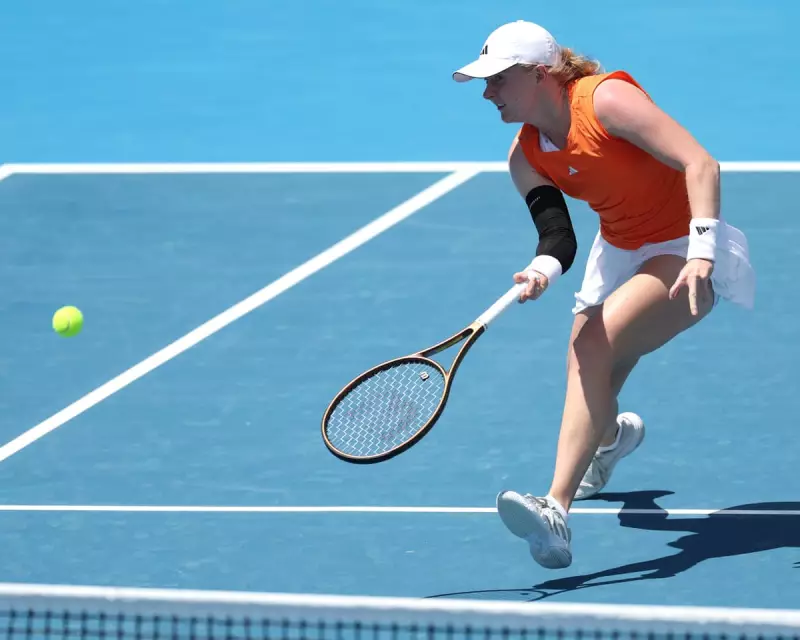
British tennis professional Francesca 'Fran' Jones has authored one of the sport's most compelling narratives, breaking into the world's top 70 for the first time following a remarkable week at the ASB Classic in Auckland. Her breakthrough, however, was tempered by a familiar setback, retiring from her quarter-final against China's Wang Xinyu due to a groin injury.
A Breakthrough Week in New Zealand
The 2026 season began with a statement victory for Jones. In her opening match in Auckland, she secured the best win of her career, stunning world number 15 Emma Navarro in a gripping three-set battle. This marked her maiden victory over any player ranked inside the global top 40.
Her resilience was on full display again in the second round. Facing Sinja Kraus and staring down the barrel of defeat at 1-6, 0-3, Jones staged an improbable comeback, winning 11 of the next 13 games to secure her place in the last eight. This run marked her fourth career WTA quarter-final, a testament to her grit and determination.

The Constant Challenge: Overcoming EEC Syndrome
Jones's career has been defined by a relentless battle with her own body. She was born with the rare genetic condition Ectrodactyly Ectodermal Dysplasia (EEC). This means she has three fingers and a thumb on each hand and seven toes in total, presenting profound physical challenges.
The condition impacts her tennis on a fundamental level. Gaining and maintaining the strength to compete at the elite level is a constant struggle. A basic requirement—gripping a racket—becomes a challenge; if she takes a few days off training, her hands cramp under the strain upon her return. During her youth, while peers developed their games, Jones underwent multiple surgeries related to her condition.
A Career Forged in Resilience
The physical toll has been severe. In 2024 alone, Jones contested 20 tournaments. She was forced to retire mid-match in seven of those events and withdrew from another tournament altogether. This meant in 40% of the tournaments she entered, her body prevented her from finishing.
A harrowing example occurred during the 2025 clay season in Bogotá. Exhausted and two points from defeat in a second-round match, she collapsed while serving and had to be wheeled off the court. These incidents highlight the extreme adversity she faces.
Despite this, Jones has never allowed EEC to define her. In recent years, she has focused intensely on improving her physical durability. This work bore fruit in the latter half of last season, where she won two WTA 125 titles and reached the semi-finals of a WTA 250 event in São Paulo. Her ranking has soared from outside the top 150 to a new career-high of 72 following her Auckland efforts.
Playstyle, Personality and Future Prospects
Jones, who trained at the Sánchez Casal Academy in Barcelona, plays a game reminiscent of Spanish baseliners, built around a heavy topspin forehand and relentless determination. Clay is her favoured surface. Off the court, she is known as approachable and sociable, yet fiercely independent and driven to maximise her potential.
Breaking into the top 100 guarantees her entry into main draws of major tournaments, offering consistent competition against the world's best. While she believes she is capable of more, this milestone represents an astounding achievement given her journey.
The quarter-final retirement in Auckland was a painful reminder that her path remains fraught with physical challenges. Yet, her start to 2026 has unequivocally shown that Fran Jones is the protagonist of one of tennis's most inspirational stories—a story of extraordinary talent battling overwhelming odds, and one that, with luck, is only just beginning.