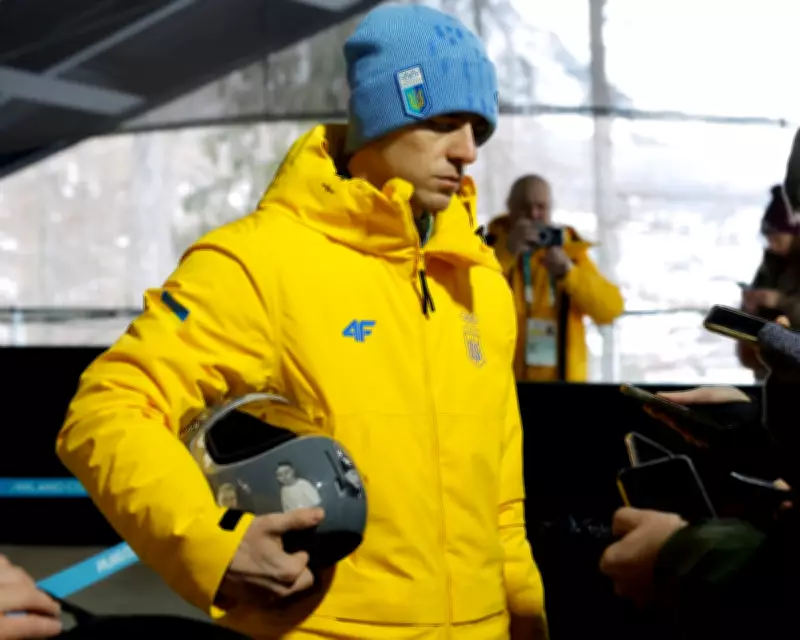
Ukrainian Skeleton Star's 'Helmet of Memory' Sparks IOC PR Crisis at Winter Olympics
Vladyslav Heraskevych, the Ukrainian skeleton racer, stood firm with his 'helmet of memory' after being disqualified from the Winter Olympics event, creating a public relations fiasco for the International Olympic Committee. Heraskevych sacrificed his medal dreams to spotlight the horrors of the war in Ukraine, honoring over 600 athletes and coaches killed since 2022.
A Defiant Stand Against IOC Rules
To be an Olympic-class skeleton racer demands extraordinary courage and nerve as corners flash by at terrifying speeds. Nobody truly believed Heraskevych would waver under global scrutiny. The IOC oscillated between expulsion threats and negotiations over two weeks, failing to sway his resolve. In conversations, Heraskevych emerged as a man ready to forfeit a Winter Olympic medal for a greater cause, stating he would not retreat.
His public and private stance remained unwavering: if barred for wearing his commemorative helmet, he would accept the consequences. At 8:30 AM on Thursday, he delivered a resolute message: "This is price of our dignity," alongside an image of his helmet. For the IOC, it was akin to witnessing an unavoidable public relations catastrophe from the front row.

Strategic Messaging and IOC Inconsistencies
Heraskevych's approach was shrewd and precise. Instead of directly addressing Russian aggression, he focused on honoring fallen friends, arguing this did not breach IOC rules against political expression on the field of play. While not universally accepted, this was a deft maneuver. He also highlighted IOC inconsistencies in enforcing expression rules, noting examples like Israeli skeleton racer Jared Firestone wearing a kippah at the opening ceremony to remember Munich massacre victims, and US skater Maxim Naumov displaying a photo of his deceased parents.
Heraskevych questioned why his case differed, especially since IOC regulations are meant to be uniform across ceremonies and competitions. The IOC attempted to prevent this controversial moment, allowing helmet use in practice and offering a black armband for competition. IOC President Kirsty Coventry traveled to Cortina in a last-ditch effort, leaving in tears, showcasing her compassion and leadership—a stark contrast to predecessors like Thomas Bach and Avery Brundage, known for rigid stances on athlete protests.
Historical Context and Ongoing Controversies
The IOC clings to the outdated notion that sport and politics can be separated, yet recently considered reintegrating Russia into international sports. Russia has a history of cyber-attacks on Olympic events and state-sponsored doping scandals, such as the 2014 Sochi Games urine-swapping scheme. Ukraine reports over 800 sports facilities destroyed by Russia, including Olympic training centers.
While Heraskevych and Global Athlete accuse the IOC of aiding Russian propaganda, the ban on his tribute appears particularly tone-deaf as Ukraine faces ballistic missile attacks. Many in Milan debated if the IOC could have acted differently, with the core issue being the sanctity of the field of play from political protests. An insider warned that approving the helmet might set a dangerous precedent, potentially allowing forced memorials by other nations.
Potential Solutions and Lasting Impact
Perhaps the IOC could have established an independent panel, similar to the one for Authorised Neutral Athletes, to handle such cases. Alternatively, turning a blind eye might have caused a brief stir before the fast-paced Olympic news cycle moved on. Regardless, Heraskevych achieved his goal: refocusing attention on Ukraine's war atrocities. With the Russian team set for the Winter Paralympics and Olympic reinstatement rumors, this decision likely delays such moves.
Heraskevych may have lost his competition battle, but he decisively won the public relations war, ensuring the plight of Ukraine remains a global talking point.