

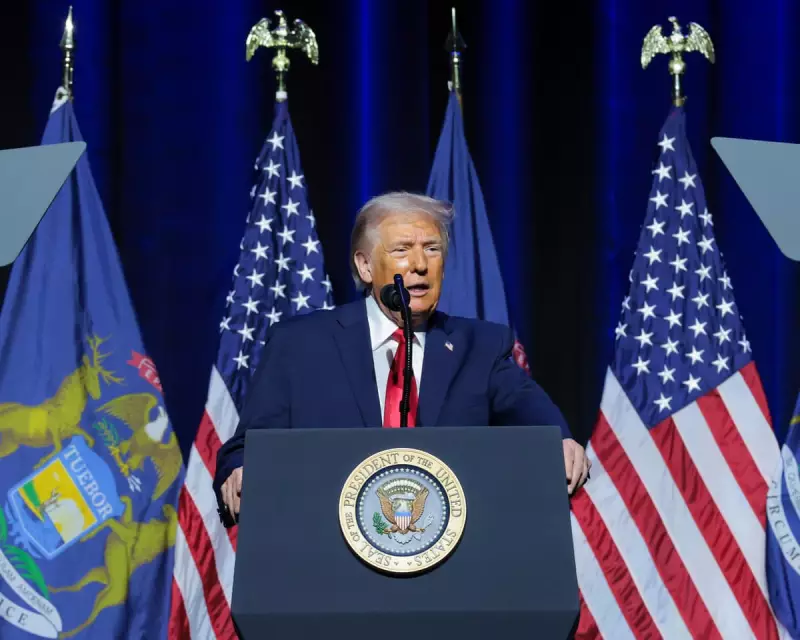
Former President Donald Trump has proclaimed his first year back in office as the "greatest" in history for the US economy, delivering a bullish assessment that clashes with widespread public concern over the cost of living.
A Triumphant Speech in Detroit
Addressing the Detroit Economic Club at the MotorCity Casino Hotel on Tuesday, Trump painted a rosy picture of his economic stewardship. He asserted that prices are falling and productivity is "smashing expectations," claims that stand in direct contrast to official government statistics.
"We’ll go down as the greatest first year in history that nobody’s ever had, just based on the numbers," Trump told the audience in Michigan. He pointed to data showing inflation had stabilised and that the economy grew at a higher pace towards the end of 2025.

The Data Behind the Declarations
However, a closer look at the economic landscape reveals a more complex and turbulent picture. While inflation has retreated from its peak, it remains stubbornly elevated. After dipping to a four-year low of 2.3% in April 2025, it climbed back to 3% by September. The economy also contracted in the first quarter of 2025, marking its first shrinkage since 2022.
The labour market, which Trump omitted from his speech, experienced its weakest year since the pandemic, with the unemployment rate rising to a four-year high. In a controversial move last August, Trump fired the federal official overseeing labour statistics shortly after data showed jobs growth had stalled.
Ongoing Feud with the Federal Reserve
A significant portion of Trump's remarks continued his extraordinary campaign to influence the independent Federal Reserve. He blamed a "real stiff Fed" for holding back stock market rallies and reiterated his desire for lower interest rates.
Trump also took fresh aim at Fed Chair Jerome Powell, who is under a criminal investigation related to testimony about renovations at the central bank's headquarters. Referring to the end of Powell's term in May, Trump said, "The jerk will be gone soon." Powell has defended the Fed's independence, stating policy must serve the public, not presidential preferences.
Wall Street continues to trade near record highs, yet Trump insisted the Fed's caution was stifling further gains.
Policy Pledges and Political Pressure
With the November midterm elections approaching, the Trump administration has begun rolling out policy proposals aimed at addressing affordability. Trump deflected responsibility for current economic challenges onto his predecessor, Joe Biden, despite inflation having cooled to around 3% when Biden left office.
Trump championed his tariff strategy as a key to success, claiming it delivered "trillions of dollars of new investment." Although these tariffs caused significant market turbulence and many remain paused or in legal limbo, Trump suggested he would persist with them regardless of an upcoming Supreme Court ruling on their legality.
He also listed new initiatives, including:
- Plans to ban large institutional investors from buying single-family homes.
- A proposal to purchase $200bn worth of mortgage bonds.
- Pushing credit card companies to cap interest rates.
Trump argued that efforts to lower drug prices alone should secure victory in the midterms. He announced intentions to detail further housing policies at the World Economic Forum in Davos next week.
Public sentiment, however, diverges sharply from the president's optimism. A recent Harris Poll for the Guardian found that twice as many Americans believe their financial situation is worsening rather than improving, underscoring the political risk of a perceived disconnect between Washington and Main Street.






