

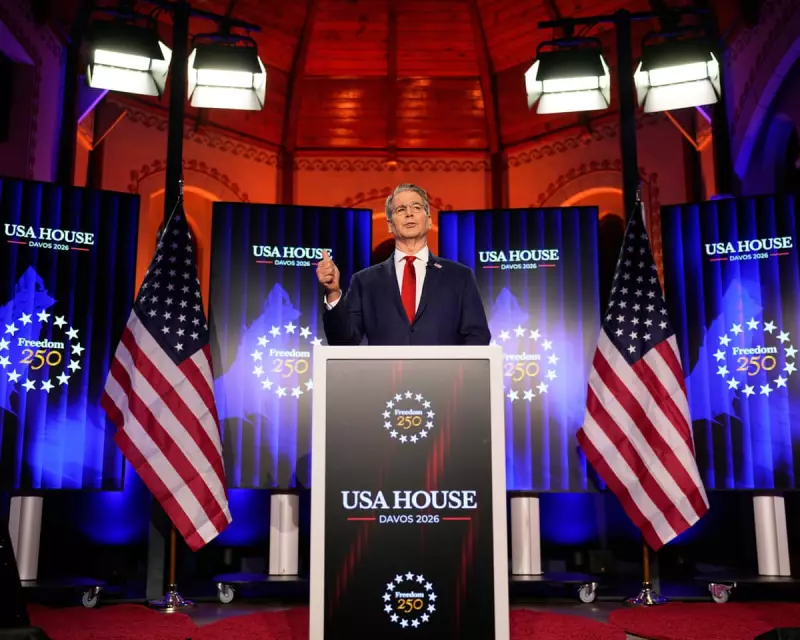
US Treasury Secretary Scott Bessent has called on European nations to avoid retaliatory measures following the announcement of new US tariffs linked to the Greenland crisis. Speaking at the World Economic Forum in Davos, Bessent urged a pause in escalation, advising governments and companies to "let things play out."
Davos Appeal for Calm Amid Market Turmoil
Addressing a press conference at the annual gathering of global leaders, Bessent dismissed the current reaction as "hysteria," comparing it to the market panic seen on 2 April last year. He argued that the situation surrounding Greenland was distinct from previous trade disputes and that the worst course of action would be for countries to escalate tensions against the United States.
His comments came as global financial markets reacted sharply to President Trump's threat of a 25% tariff on a range of European goods, a move tied to his administration's pursuit of the autonomous Danish territory. Stock indices in Asia and Europe fell, with the UK's FTSE 100 losing 111 points, while the US dollar also declined.

Debt Dismissal and Deutsche Bank Critique
Bessent specifically rejected the notion that European countries might retaliate by selling off their vast holdings of US government debt, a strategy some analysts have speculated could be a potent weapon. He labelled this a "completely false narrative" that defied logic.
The Treasury Secretary appeared to be referencing a research note from Deutsche Bank analyst George Saravelos, who had pointed out that European entities own approximately $8 trillion in US bonds and equities. Saravelos questioned why Europe would continue to fund US deficits amid such significant geoeconomic disruption.
Bessent countered by expressing confidence that European governments would continue to treat US debt as a "risk free" asset, crucial for global financial stability. This is despite the US national debt exceeding $38 trillion and the country running a deficit of $1.78 trillion in 2025.
Broader Trade Tensions and IMF Warning
The Greenland dispute is not occurring in isolation. Overnight, President Trump further inflamed tensions by threatening 200% tariffs on French wines and champagne, following reports that President Emmanuel Macron was reluctant to join a proposed Gaza peace initiative.
The head of the International Monetary Fund, Kristalina Georgieva, also speaking in Davos, issued a stark warning against a renewed tit-for-tat trade war. She noted that the global economic outlook had improved partly because the impact of previous tariffs had been muted, and urged leaders to maintain that stability for the sake of the world economy.
Meanwhile, the European Union's top diplomats held crisis talks, reportedly discussing reviving a suspended plan to levy tariffs on €93 billion worth of US goods. The situation remains fluid, with President Trump scheduled to address the World Economic Forum directly, leading to heightened uncertainty on trading floors worldwide.






