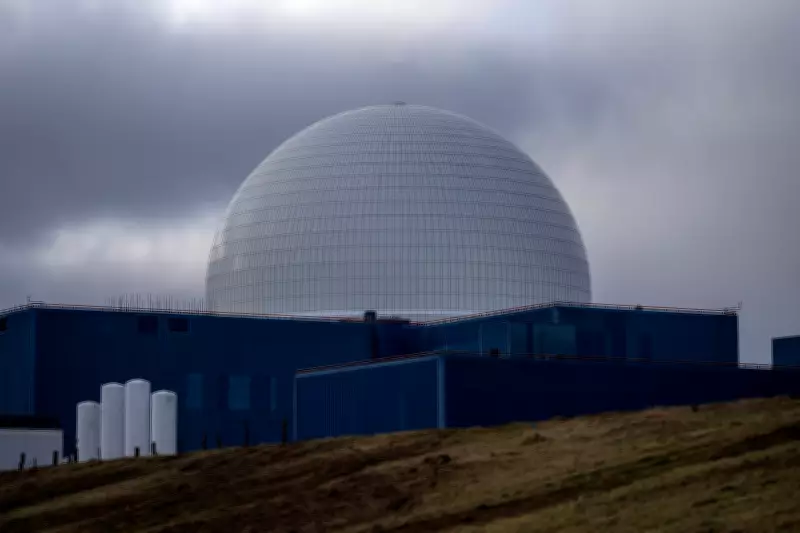
If you were to judge by ministerial speeches, nuclear energy is at the heart of Britain’s ambitions. Yet, despite enthusiastic rhetoric and firm commitments, progress remains painfully slow. Daniel Skeffington and Edward Barlow examine why the government’s nuclear strategy is stuck in neutral.
Rhetoric vs. Reality
The government now talks about nuclear with seriousness and enthusiasm unimaginable a decade ago. The Prime Minister has asserted that “energy security is national security,” while the Chancellor has written that “to build national resilience, drive energy security and deliver economic growth, we need nuclear.” Against a looming energy crisis, nuclear is clearly central to government plans.
Better yet, the government has backed up rhetoric with firm commitments. The Budget pledged £14 billion to Sizewell C. Decisions have been made on small modular reactors at Wylfa. The radical regulatory overhaul recommended by the Fingleton Review has been accepted in full. At first sight, this appears to be full steam ahead for British nuclear, removing many long-standing inhibitors.

But ambition is no longer the problem. The question has ceased to be ‘does Britain want a nuclear future?’ but ‘does it have a state that can deliver it?’ As noted by the Policy Exchange Nuclear Enterprise Commission in a previous report, the government must go much further than regulatory reform alone if it is to deliver a “golden age” for nuclear energy. The Commission’s latest report, The Nuclear State, places nuclear governance reform at the forefront of these efforts.
UK Nuclear Needs Fewer Speeches, More Infrastructure
Much attention has been paid to the sorry state of Britain’s “Rolls-Royce civil service.” But its nuclear enterprise is no different. The problem is not a shortage of ministerial speeches, headline commitments, or declared support. It is that the machinery behind them is fragmented, indecisive, and badly designed for long-term national missions.
Nuclear programmes are not like ordinary policy initiatives; approval discussions outlast not just parliaments, but in some cases, whole political careers. For example, the time between the initial identification of Sizewell C as a suitable site and its final investment decision was 14 years – equivalent to 104 Liz Truss ministries.
Nuclear projects require a governance architecture capable of maintaining focus across ministerial churn, fiscal squeezes, and all manner of political vicissitudes. As such, they depend on institutions that can force trade-offs, effectively prioritise, and avoid the drift and deferral that has characterised Britain’s nuclear enterprise.
Delay and Drift Are Baked into the System
Every deferred decision doesn’t just force nuclear down the ever-expanding list of priorities. It also weakens investor confidence, pushes costs higher, hollows out skills, and makes the next round of investment harder to justify. By the time ministers and the public notice the damage, the system has already locked itself into underperformance.
The civil nuclear system demonstrates this chain of deferral, drift, deprioritisation, and eventual underperformance most clearly. DESNZ holds overall policy responsibility, but its arms-length body Great British Nuclear is responsible for delivery and programme development. Similarly, another core stakeholder, the Office for Nuclear Regulation, is entirely out of DESNZ’s control as it is sponsored by the Department for Work and Pensions. Beyond this, the Cabinet Office, Department for Education, and Department for Science, Innovation and Technology all hold pieces of the puzzle as well – with no department owning the process from one end to the other.
This is not a serious delivery machine; it is a recipe for drift and dysfunction. The defence side is more coherent because it operates more explicitly as an enterprise. But it is not immune to governance problems either. There are still coordination challenges between long-term capability planning and day-to-day operations, especially at the boundary between those responsible for sustaining today’s force and those preparing tomorrow’s. Those boundaries should be governed more deliberately.

At a larger scale, there is a pronounced lack of alignment between the civil and defence parts of the enterprise. These are distinct domains, but they often draw on the same national capabilities: skills, supply chains, decommissioning, and R&D. Despite this, they rarely interact unless circumstances force them to.
Britain is one of the world’s leaders in small modular reactors. This is thanks in large part to defence applications linked to the submarine fleet. But unlike France, the UK has not consistently treated civilian SMRs as strategic national assets. The result is that a country with genuine technical advantages still behaves like one without a plan.
How to Solve Our Nuclear Malaise
The answer, however, is not simply to create a Ministry for Nuclear. This would risk adding another bureaucratic seam while leaving the underlying failure of coordination untouched. Nuclear policy is too deeply embedded in wider energy planning, industrial strategy, and defence policy to be solved by a departmental carve-out alone.
What is needed instead is a more disciplined nuclear state.
First, and most simply, the government should introduce anti-drift mechanisms. Deferral should no longer be Whitehall’s default response. Instead, programme slippage should trigger automatic escalation to progressively higher levels of authority. Ministers should have to explicitly sign off on “do nothing” outcomes, such as delay or cancellation. The intention is not to force approval, but to force accountable, timely decisions.
Second, civil nuclear needs an integrating centre. A genuine Civil Nuclear Enterprise, led by a Civil Enterprise Board and a Chief Civil Nuclear Officer within DESNZ, would give government end-to-end ownership of civil nuclear strategy and delivery, providing the system integrator that civil nuclear currently lacks.
Finally, once the civil side has been made more coherent, a formal civil-defence alignment framework should follow. This should introduce a statutory requirement on the relevant departments to produce joint cooperation plans in the defined shared domain, alongside joint civil-defence governance boards with decision-making authority.
Britain has already succeeded in raising popular and political support for nuclear energy and for its nuclear deterrent. It now needs a state capable of making decisions, foreclosing endless cycles of delay. If the government is serious about making nuclear central to Britain’s future, then it must stop treating governance as an afterthought. The choice is now stark: build a nuclear state capable of delivering on its promises, or face further nuclear decline. Unless ministers address the machinery of government, nuclear will remain a national ambition trapped in a dysfunctional system. Applauded in speeches, delayed in practice, and squandered in the gap between the two.
Daniel Skeffington is a senior fellow and coordinator for the Policy Exchange Nuclear Enterprise Commission; Edward Barlow is a research fellow in Policy Exchange’s National Security Unit.