

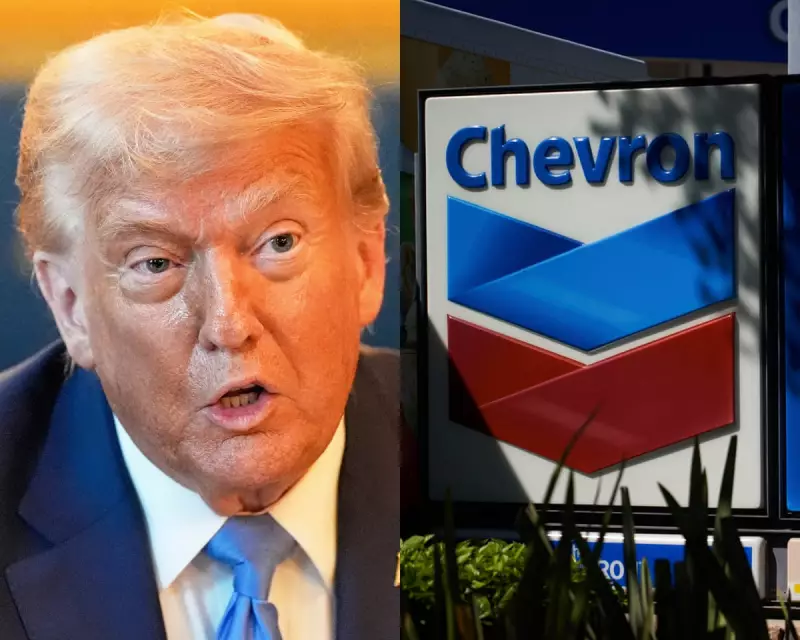
Major American oil corporations have offered no public endorsement of Donald Trump's assertion that they are prepared to pour "billions and billions of dollars" into revitalising Venezuela's crippled petroleum sector following the political ouster of Nicolás Maduro.
Corporate Silence Follows Presidential Pronouncement
The former US president, speaking from his Mar-a-Lago estate, outlined a vision where US energy multinationals would be central to modernising and exploiting Venezuela's vast reserves, reputedly the largest in the world. He claimed these firms would reconstruct "rotted" infrastructure, significantly ramp up production, and sell large volumes internationally, stating bluntly: "We're in the oil business."
"We're going to have our very large United States oil companies – the biggest anywhere in the world – go in, spend billions of dollars, fix the badly broken infrastructure and start making money for the country," Trump told reporters, adding that the companies would be "reimbursed" without providing specific details.

In response to these claims, ExxonMobil, the largest US oil company, and ConocoPhillips did not respond to requests for comment. Chevron, which holds the distinction of being the sole US oil firm still operating in Venezuela, issued a carefully worded statement that notably did not address investment plans.
A Chevron spokesperson said: "Chevron remains focused on the safety and wellbeing of our employees, as well as the integrity of our assets. We continue to operate in full compliance with all relevant laws and regulations."
A History of Nationalisation and Legal Battles
The potential return of American oil giants to Venezuela is fraught with historical complexity. The nation nationalised its oil industry roughly five decades ago and later seized control of remaining privately-run operations in 2007. While Chevron agreed to stay under new terms, ExxonMobil and ConocoPhillips exited, leading to a protracted legal fight.
Both companies were ultimately awarded billions of dollars in compensation by the World Bank's International Center for Settlement of Investment Disputes. However, Venezuela's sanctions-battered economy, plagued by mismanagement and corruption, has failed to pay the full amounts owed.
Currently, a comprehensive US embargo on Venezuelan oil remains in full force, according to Trump, whose administration has long accused Caracas of appropriating American wealth. The legality and practical next steps of the proposed plan are under intense scrutiny.
Analysts See Significant Obstacles to Major Investment
Industry experts were sceptical that companies would hastily commit the colossal sums suggested. Jorge León, head of geopolitical analysis at consultancy Rystad Energy, suggested that while Trump's public comments may imply prior consultation, significant barriers remain.
"My hunch is that, if President Trump said this publicly, probably there was already an agreement with the US companies," León stated. "But companies, before rushing back into the country, will want to see the country is stable enough. The fact this industry was nationalised by [Hugo] Chávez a few years ago, that remains in the back of their minds."
The scale of the challenge is monumental. Venezuela's oil output has collapsed from a peak of 3.5 million barrels per day in the 1970s to around 1 million barrels daily last year, representing just 1% of global production. Rystad Energy estimates that returning production to 2 million barrels per day by the early 2030s would require an investment of approximately $110 billion.
León also pointed out that the global oil market is "entering into a period of oversupply," which will make firms "very, very selective" about where they invest. "Given the choice, they will probably want to go investing in places they already know," he added.
However, other observers foresee fierce competition for access. Tina Fordham, founder of Fordham Global Foresight, described Venezuela as "a huge opportunity" for major firms, predicting "immense competition between them for the best opportunities."

The proposal also evokes cautionary memories of other complex post-regime transitions, such as those in Afghanistan, Iraq, and Libya. Fordham noted, "The history of post-authoritarian transitions, whether they are organic or externally brought about, is long and non-linear. Trump appears to have complete faith that, under him, things will be different."
According to a Politico report citing unnamed sources, US administration officials have recently told oil executives that if they seek compensation for seized assets in Venezuela, they must return and make substantial new investments.





