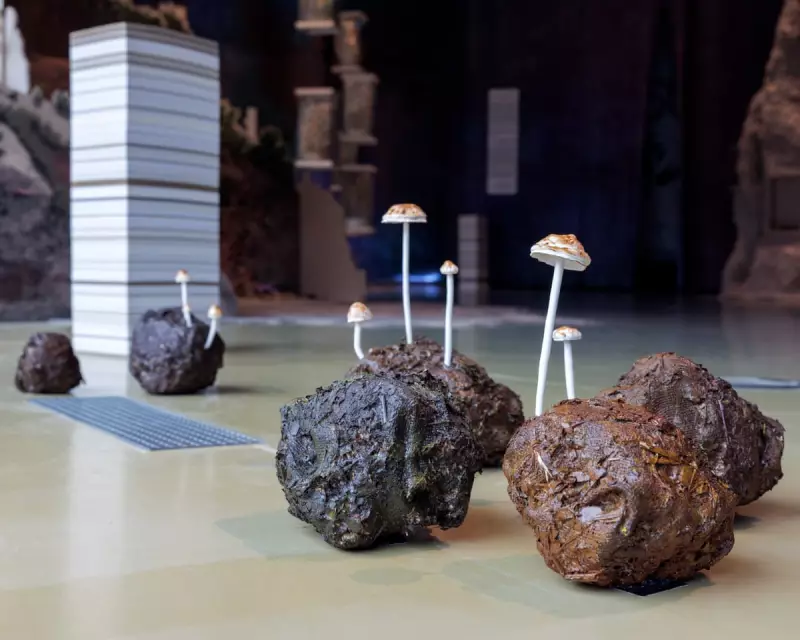
A major new exhibition in the Netherlands is casting fungi not as passive materials but as active, anarchic forces shaping our world. Fungi: Anarchist Designers at Rotterdam's Nieuwe Instituut takes visitors on a Dantean journey through the unsettling and omnipotent realm of fungal life. The show, which runs until 8 August, reveals how these organisms have poisoned emperors, hijacked insect brains, and even survived atomic blasts.
More Than Just Mushrooms: The Perverse Power of Fungi
The exhibition opens with Sylvia Plath's foreboding 1959 poem, Mushrooms, setting a tone of sinister omnipresence. Curators anthropologist Anna Lowenhaupt Tsing and artist Feifei Zhou frame fungi as entities that "refuse the commands of human masters." Instead of focusing on trendy mycelium-based products, the show highlights "anti-design," presenting fungi as "co-designers of the world" that exploit human folly.
From microscopic yeasts to vast networks, the fungal domain encompasses over two million species. A timelapse film of a basket stinkhorn—which emits a rotting flesh smell to attract spore-dispersing flies—epitomises their perverse, ingenious life cycles. The exhibition details how the death cap mushroom (Amanita phalloides) caused the demise of Holy Roman Emperor Charles VI in 1740 and has since spread globally due to human cultivation of non-native trees.

Exploiting Human Error: From Forests to Hospitals
Fungi thrive on human-made vulnerabilities. Vast monoculture plantations of sweetcorn, bananas, and coffee, with their genetic uniformity, are perfect targets for fungal epidemics. A multimedia installation by forest pathologist Matteo Garbelotto and artist Kyriaki Goni visualises the devastating spread of heterobasidion root rot through conifer forests.
The threat extends beyond plants. A giant tombstone in the exhibition lists over 90 amphibian species driven to extinction by a microscopic fungus, with a magnified image showing the fungus piercing a corroboree frog's skin. References to the popular series The Last of Us ground its fiction in the real, horrifying biology of cordyceps, which controls insect brains.
Human health is also in the crosshairs. A mock hospital bed serves as a shrine to Candida auris, a multi-drug-resistant fungal infection that kills up to one in three patients it infects in healthcare settings.
Beauty in Decay and Visions of Regeneration
Despite their destructive power, the exhibition finds a compelling beauty in fungi. Historic architectural drawings from the institute's archive are displayed with their natural fungal discolourations, resembling Rorschach tests. Japanese artist Hajime Imamura creates delicate "mycelial sculptures" that drape across ceilings, while Lizan Freijsen crafts rugs that mimic patches of dry rot—a fungus that spread globally via colonial trade routes.
A poignant note of resilience comes from the matsutake mushroom, one of the first living things to emerge from the atomic-bombed landscape of Hiroshima. A lyrical film by Shiho Satsuka and Liu Yi explores this relationship, suggesting fungi can make damaged landscapes habitable again.
The final installation, "architecture must rot," features plywood cocoons in sealed terraria being broken down by live fungi. It challenges the notion of permanent architecture and reimagines decay as a positive, regenerative force. The exhibition concludes with a corridor of manifestos urging a radical rethink of human interdependence with the more-than-human world.
Atmospheric and richly detailed, Fungi: Anarchist Designers is a thoroughly engrossing, if disquieting, experience. It ensures you will never look at a mushroom—or the silent, pervasive power it represents—in the same way again.