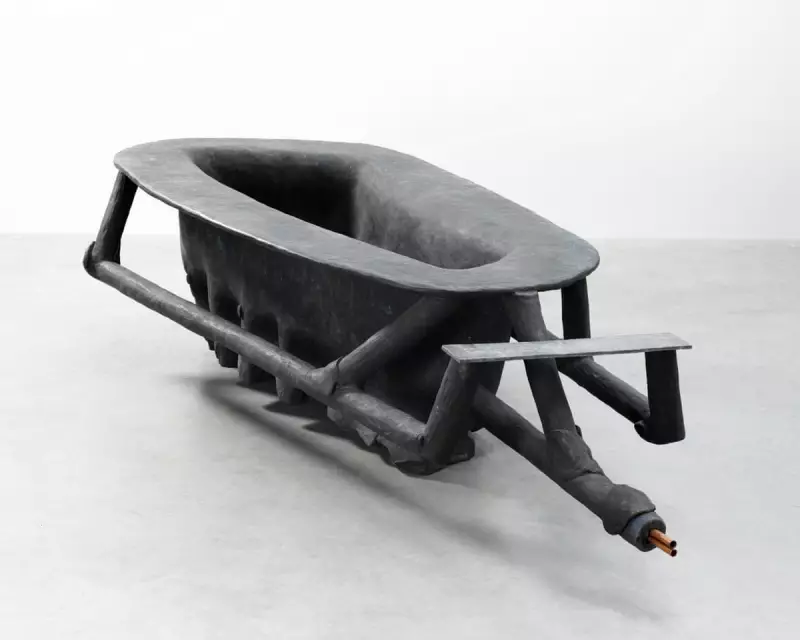
A Monumental Vessel of Memory and Myth
A powerful and unsettling new exhibition in London confronts visitors with the monumental legacy of German artist Joseph Beuys. At the heart of the show at Thaddaeus Ropac Gallery is the commanding sculpture Badewanne (Bathtub), a work the artist developed from 1961 until near his death in 1986. This is not a place for cleansing but for immersion in the traumatic tides of modern history.
The exhibition, titled Bathtub for a Heroine, presents the artist at his most mythic and Wagnerian. Beuys, born in 1921, carried the physical and psychological wounds of his service in the Luftwaffe during the Second World War. The show is complemented by Andy Warhol portraits that capture his gaunt, ravaged face, a stark reminder of the past he continually addressed.
An Object of Entropy and Unforgettable Power
While Beuys was famed in the 1970s for his radical performances and ecological activism, his material sculptures have taken on profound weight since his death. Bathtub embodies this shift. It is a massive, steampunk-like metal tank with protruding pipes and valves, its interior textured like rumpled flesh. The entire structure rests ominously on a giant mammoth tooth.

Cast in 1987 from his long-evolving design, the work is deliberately sinister. It offers no relaxing soak but instead a plunge into what the critic describes as "the black bile of modern history." Its pipes seem connected to the century's worst horrors, making it a static, powerful object of entropy—all the more compelling for its grim solidity.
Seeking Purity in Prehistory
The exhibition traces Beuys's lifelong search for a redemptive, prelapsarian German mythology, reaching back far beyond the Nazi era. This is evident in works like Mammoth Tooth, Framed (1961), which features a real fossilised tooth supporting a small copper bathtub—a maquette for the larger work.
Here, Beuys looks to the Stone Age, inspired by figures like the Venus of Willendorf. His 1949 sculpture Lead Woman and dreamy watercolours such as Female Figure (1954) attempt to redeem archetypal female forms from Wagnerian myth, imagining a national identity purified by deep time.
Yet, for all this quest for purity, Bathtub itself refuses absolution. The critic observes it resembles a "coffin for a Valkyrie," its jagged form heavy with inescapable memory. Its pipes are as unequivocally linked to the machinery of mass murder as the rusty rails in his famous Tramstop installation are to Auschwitz.
The exhibition serves as a potent reminder of Beuys's dual legacy. He provided a shattered post-war Germany with access to its own mythic past and laid the groundwork for artists like Georg Baselitz and Anselm Kiefer. His work represents a "joyous yet cursed creativity," ultimately offering not a balm but a bath in history's most corrosive acids. The show runs at Thaddaeus Ropac Gallery, London, until 21 March 2025.