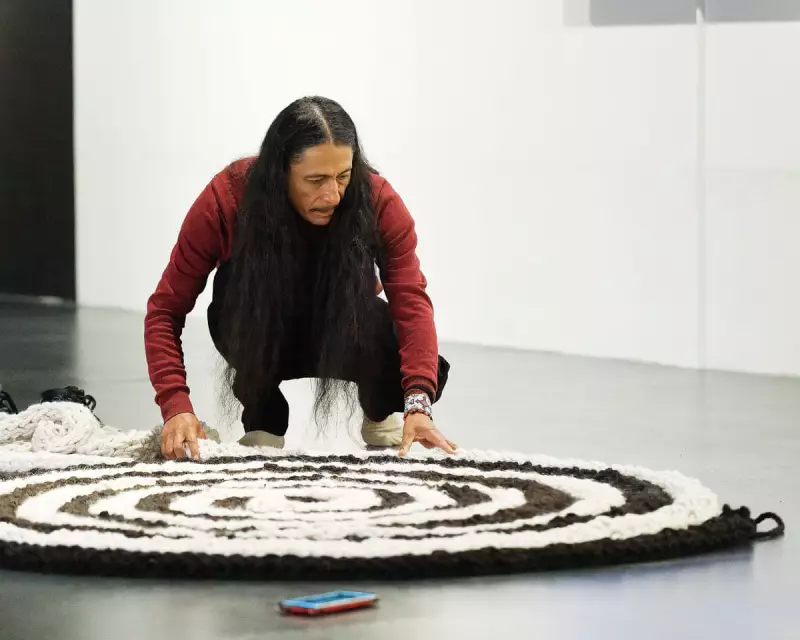
An artist and beekeeper from the remote Peruvian Andes has been awarded one of the United Kingdom's most significant contemporary art prizes, with plans to invest the £40,000 winnings into building a cultural centre in his homeland.
From the Andes to Wales: A Journey of Recognition
Antonio Paucar was named the winner of the biennial Artes Mundi prize, an award based in Wales dedicated to showcasing globally important artists who often work outside the mainstream spotlight. Paucar's winning presentation featured a range of compelling works, including a large-scale spiral sculpture crafted from hand-woven alpaca wool and a poignant video piece where he writes a poem in his own blood about the environmental crisis.
Speaking to The Guardian in Cardiff ahead of the ceremony, Paucar expressed his surprise and gratitude. "I didn't expect it. The journey of an artist is very difficult," he said. "For me this kind of recognition is very important for my region, my country, my culture. It gives me strength to continue developing new projects."

Art Rooted in Nature and Culture
Hailing from the village of Aza in central Peru's Junín region, Paucar comes from a family of traditional mask and figure makers. Before pursuing art studies in Berlin, he worked as a beekeeper in the Peruvian highlands—a practice he continues alongside his artistic career, maintaining a rural lifestyle.
His exhibited work is deeply connected to Andean cosmology and the pressing issue of ecological degradation. A central piece, titled 'La Energía Espiral del Ayni', is a spiral formed from black and white alpaca wool. Paucar explains that 'Ayni' is a Quechua concept representing reciprocity and the interconnectedness of all things.
"It has allowed people in the Andes to maintain a balance with nature," he stated. "Life is not linear like the European way of thinking... We are circular." He noted the symbolic difficulty of sourcing black alpaca wool, as the textile industry's demand for easily dyed white wool is causing the natural black colour to disappear.
Another powerful work, 'El Corazón de la Montaña' (The Heart of the Mountain), features a video of Paucar at a desk in the mountains, inscribing a message with his blood: "The glaciers in the Andes are crying/With their mournful cry they melt forever."
Creating Dialogue Across Continents
Paucar's work is displayed across five Welsh galleries as part of the Artes Mundi exhibition, including the National Museum Cardiff and Mostyn in Llandudno. One installation at Mostyn involved the artist walking barefoot on the Great Orme headland and then performing a handstand in the gallery, leaving ghostly footprints on the wall.
He has observed meaningful parallels between his own culture and that of Wales. "The Celtic culture was very linked to nature. That is also the case with the Andean culture. Maintaining the language is also important in Wales and where I am from," Paucar reflected.
Nigel Prince, Director of Artes Mundi, welcomed these connections, stating the prize aims to focus on shared human experiences. "In today's global context, where there often can be an emphasis on focusing on difference as a means to divide and rend apart, I actually think that opens up a sort of sharing and a dialogue," he said.
The exhibition, which also features five other shortlisted artists, is expected to attract up to 150,000 visitors before it concludes. The Artes Mundi exhibition continues at venues across Wales until 1 March 2026.