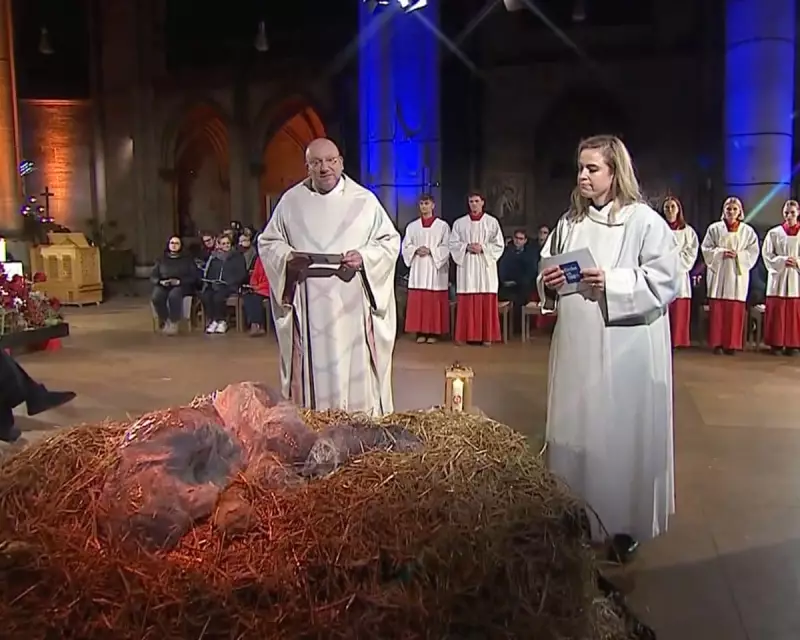
A televised Christmas Eve service in Germany has ignited a fierce backlash after featuring a controversial artistic interpretation of the baby Jesus, described by critics as a 'slime Jesus'. The broadcast, which aired nationally on ARD from St Mary's church in Stuttgart, has drawn over 1,400 viewer comments and forced a Catholic diocese to issue a formal apology.
An Unconventional Nativity Scene
The source of the controversy was a live nativity scene designed for the broadcast. Instead of a traditional doll or statue, a female performance artist, Eleni Sismanidou, was curled in a foetal position within the manger. She was covered in sticky rice paper, intended to represent the vernix that coats a newborn.
During the service, the officiating priest, Thomas Steiger, who is employed by the regional broadcaster SWR, addressed the scene directly. He stated, "The nativity scene shows a real human being, lying there miserable, naked and exposed." As he spoke, the actor breathed heavily and writhed slowly within the paper. Steiger added, "This is how radically God becomes human: close, touchable, without distance, real."

The show's designer, Milena Lorek, later explained on Instagram that the scene was conceived as "a moment of uncertainty between safety and distress."
A Storm of Criticism and Mockery
The reaction from segments of the public and media was swift and largely negative. Germany's largest tabloid, Bild, led with the headline "ARD shows Christmas mass with slime Jesus". It quoted viewers who compared the figure to a "breathing alien" and condemned the spectacle as "sick and twisted".
Right-wing media outlets, long critical of Germany's public broadcasting fee system, seized on the incident as an example of perceived excess. The backlash also entered the political sphere. Klaus Nopper, a Christian Democrat member of Stuttgart's city council, called the display "disgusting".
"This is the Christmas story being hijacked by wokeness," Nopper said. "Lines keep getting blurred and our values thrown overboard. This is how you destroy society."
Diocese Issues Regret and Promises Review
After nearly three weeks of mounting criticism and online mockery, the Rottenburg-Stuttgart diocese finally addressed the controversy. In a statement published on Monday, it acknowledged that the broadcast had caused significant hurt.
"The reactions to the broadcast have shown that religious feelings were hurt," the diocese stated. It confirmed that Bishop Dr Klaus Krämer and the diocesan leadership had reviewed the feedback. The Catholic broadcasting service at SWR, responsible for the programme's design, "deeply regret this and emphasise that at no time was it their intention to provoke or disparage central tenets of faith."
The statement admitted that the chosen form of presentation caused "bewilderment, incomprehension and anger among many people – especially on an important holiday such as Christmas." It also conceded that deviations were made from the traditional Christmas liturgy "for the television format," calling these "incorrect."
Looking forward, the diocese pledged that future broadcasts of church services would undergo a stricter "coordination and decision-making process" to ensure they respect both church responsibility and the sensitivity of the format.