

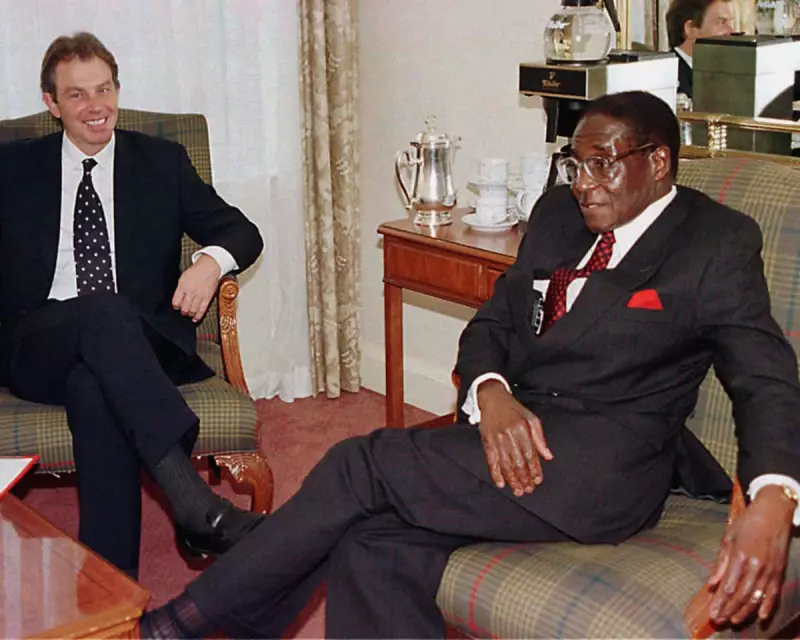
Newly released government papers have revealed that the UK Foreign Office explicitly advised against military action to overthrow Zimbabwean dictator Robert Mugabe in 2004, bluntly stating it was not a "serious option".
The Search for a Strategy in 2004
The confidential policy documents, released to the National Archives in Kew, west London, show that Tony Blair's government was actively seeking new ways to handle the "depressingly healthy" 80-year-old leader. This search for a strategy came as Mugabe's Zanu-PF party tightened its grip, with the country descending into violence and economic chaos.
In July 2004, Number 10 requested the Foreign Office produce a range of options. This request came just a year after the UK joined the US-led coalition to topple Iraqi leader Saddam Hussein. Officials conceded that the existing policy of isolating Mugabe and building international consensus for change was failing. A key stumbling block was the lack of support from pivotal African nations, notably South Africa's then-president, Thabo Mbeki.

The Three Options on the Table
The files outline three potential paths forward. The first was to "seek to remove Mugabe by force". The second involved "tougher UK measures" like freezing assets and closing the British embassy in Harare. The third, advocated by the outgoing UK ambassador to Zimbabwe, Brian Donnelly, was to "re-engage" with the regime.
The Foreign Office's analysis was unequivocal in dismissing the military route. Drawing direct lessons from recent conflicts, the policy paper warned: "We know from Afghanistan, Iraq and Yugoslavia that changing a government and/or its bad policies is almost impossible from the outside." It starkly concluded that to change the situation in Zimbabwe, "we have to do to Mugabe what we have just done to Saddam."
Why Military Force Was Ruled Out
The documents detail a sobering assessment of the immense practical and political obstacles to an invasion. The Foreign Office judged that the UK would be the "only candidate" to lead such an operation, as even the United States would not be prepared to do so. It predicted heavy casualties and warned of "considerable implications" for British citizens living in Zimbabwe.
Critically, the paper found there would be no international backing for such a move. It stated that no African state would agree to forcibly remove Mugabe short of a major humanitarian catastrophe. Furthermore, it judged that no European, Commonwealth, or other Western partner would authorise or participate.
The legal barrier was deemed insurmountable. The advice noted there would be "no legal grounds" for military action without a United Nations Security Council resolution, which the UK would not be able to secure.
Blair's 'Longer Game' and the 'Year of Africa'
With the military option off the table, Blair's foreign policy adviser, Laurie Lee, warned that Zimbabwe "will be a real spoiler" to the Prime Minister's plan. Blair aimed to use the UK's 2005 presidency of the G8 to make it the "year of Africa", culminating in the Gleneagles summit. Lee concluded that the government "probably have to accept that we must play the longer game".
Blair appeared to agree with this assessment. In handwritten notes, he suggested working to expose Mugabe's "lies and malpractice" ahead of the 2005 election, and then attempting a form of critical re-engagement afterwards. He wrote: "I can see a way of making it work but we need to have the FCO work out a complete strategy."
This aligned with Ambassador Donnelly's valedictory advice, though he acknowledged Blair "might shudder at the thought" of re-engaging given Mugabe's record.
Lasting Controversies and the Final Fall
The released files add context to long-standing controversies. In 2013, Thabo Mbeki claimed that in the early 2000s, Blair had tried to pressure him into joining a military coalition against Mugabe—an allegation Blair has strongly denied.

Robert Mugabe was finally removed from power in a 2017 coup at the age of 93. The declassified 2004 papers provide a crucial snapshot of the difficult calculations and limited options faced by the British government over a decade earlier, as it grappled with how to respond to an entrenched dictator whose rule was causing immense suffering.





