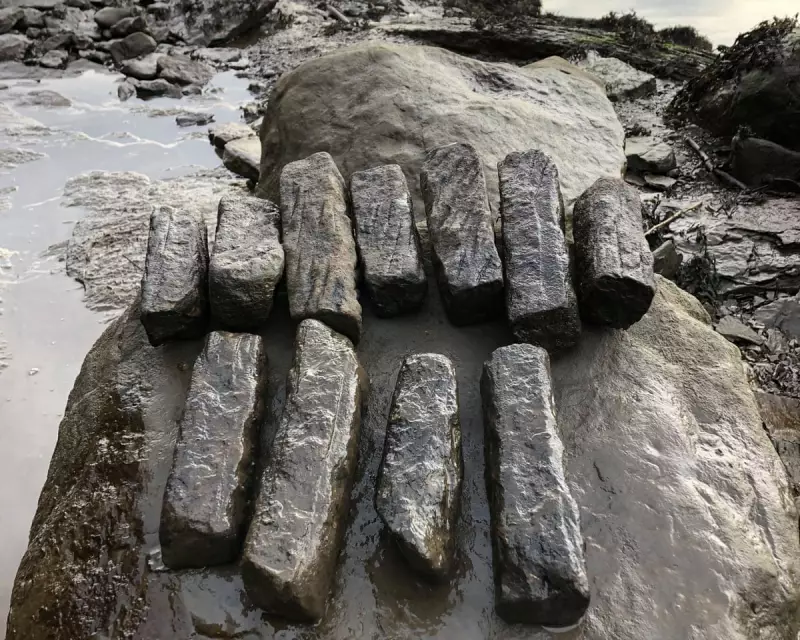
Archaeologists have made a landmark discovery on the banks of the River Wear, unearthing evidence of a vast and previously unknown Roman industrial complex. The find, described as one of the most significant in northern England for a century, centres on the staggering recovery of more than 800 whetstones, with indications that thousands more may lie buried.
A Staggering Scale of Production
Whetstones, essential stone bars used for sharpening bladed tools and weapons, were a commonplace item across the Roman Empire, carried by every soldier. Project leader Gary Bankhead, an honorary fellow of Durham University, stated that only about 250 such stones had previously been recorded across the entire British Isles. The sudden appearance of at least 800 at a single site is therefore revolutionary. "It is staggering," Bankhead remarked, confirming this as the largest known whetstone discovery in north-west Europe.
The site at Offerton, near Sunderland, is believed to have been a dedicated production hub. The theory suggests that sandstone was quarried from the river's north bank and transported to the flatter southern bank for crafting into finished whetstone bars. The location was strategically ideal for trade, with river vessels able to collect the finished goods for transfer to sea-going ships destined for other parts of Britain and the near continent.

Putting Sunderland on the Roman Map
This discovery fundamentally alters the historical narrative of the region. Bankhead emphasised that this is the first concrete archaeological evidence placing Sunderland firmly within the Roman world, despite its proximity—just 10 miles south—to Hadrian's Wall. The find not only confirms Roman presence but highlights the area's role in a sophisticated manufacturing and trade network.
Further evidence supporting Offerton's status as a major industrial hub comes from the discovery of 11 stone anchors, the largest number found at any river site in northern Europe. All the whetstones recovered were damaged or were off-cuts, which logically remained at the production site after fracturing and becoming useless, while the perfect stones were shipped out.
Community Effour Rewrites History
The site was originally discovered and excavated by dedicated volunteers from the Vedra Hylton community association, assisted by researchers and students from Durham University. Their work has unveiled what is considered the first Roman site in Britain where stone was deliberately quarried specifically for whetstone production.
Eleri Cousins, an assistant professor in Roman archaeology at Durham University, said the site has the potential "to make a significant addition to our understanding of manufacturing and industry in Roman Britain, particularly in the militarised north of the province."
Reflecting on the city's long industrial heritage, Sunderland City Council leader, Michael Mordey, said: "Ships, coal, pottery, glass and cars have all been made on the banks of the Wear... This work has revealed yet another generation of makers." He added that the discovery "shines a whole new light on the role Sunderland may have played in the Roman empire."
The full story of this remarkable find will be featured in an upcoming episode of BBC Two's Digging for Britain, with all episodes available on iPlayer from 7 January.