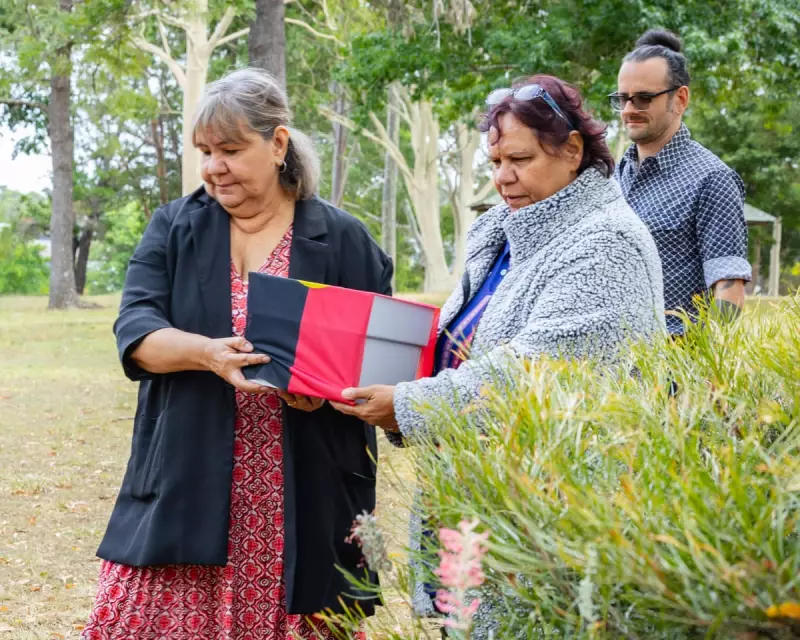
In a deeply emotional ceremony in Sydney, Waluwarra traditional owners Sylvia Price and Elizabeth Dempsey were finally reunited with the stolen remains of their Aboriginal ancestors, closing a painful chapter over a century in the making. The event marks a significant step in Australia's ongoing journey of reconciliation, highlighting both progress and the immense challenges that remain in returning Indigenous ancestors to their country.
A Century-Old Injustice Unravelled
The journey to this moment began when Price and Dempsey, via their native title body, received an email from the federal arts department. They were informed that ancestral remains, originating from a cattle station on Waluwarra country outside Mount Isa in Queensland, had been discovered at the Institute of Anatomy at the University of Cologne in Germany.
The news provoked a complex mix of emotions. "I questioned, 'how could our Australian government allow that to happen, for our ancestor's remains to be removed out of Australia?'" Sylvia Price recalls. She later came to a place of resolve, acknowledging the past cannot be changed but that moving forward is essential.

Further investigation identified two more ancestors held within Australia: one at the Australian Museum in Sydney and another at the Queensland Museum in Brisbane. Piecing together their history through morphological markers, archival records, and community knowledge became, in Price's words, "sort of like a jigsaw puzzle."
A Dark History of Trade and Exploitation
The investigation revealed a grim colonial past. Two of the ancestors were sold to the Australian Museum in 1905 by Walter Roth, then Queensland's chief protector of Aborigines. Roth, an ethnographer, collected thousands of cultural artefacts before implementing the state's oppressive Aboriginals Protection Act.
At the time, Indigenous body parts were sought-after curiosities for study and display. Roth's sale of 2,500 artefacts, including 97 human specimens, for £450 (equivalent to roughly $85,000 today) contributed to his resignation under public pressure in 1906. Records show one of the Waluwarra individuals was later traded to a German professor in 1936 in exchange for a Peruvian Inca skull.
The third ancestor was found by road workers near Mount Isa in 1973. After forensic analysis dated the remains as over a hundred years old, they were held by the state coroner until custody was transferred to the Queensland Museum's repatriation team in 2016.
The Unending Task of Repatriation
This month's ceremony represents a victory, but it is a drop in an ocean of unfinished business. More than 1,790 Aboriginal and Torres Strait Islander ancestral remains have been repatriated from 11 countries in the last 35 years, yet an unknown number remain in institutions worldwide.
Australian museums face a daunting, sensitive backlog. The Australian Museum's Director of First Nations, Laura McBride – the first Indigenous person on its executive team – emphasises these are not ancient relics but "our grandparents, our great-grandparents." Her institution holds hundreds of ancestors, with numbers constantly fluctuating.
The challenge is even more acute at the Queensland Museum, which holds about 840 ancestors. More than 30 new remains were surrendered to the institution in the past year alone, often found during construction, by erosion, or in private collections. "Our returns to community are being outstripped by the numbers of ancestors that are being returned," says Bianca Beetson, the museum's Executive Director of First Nations.
Repatriation is hampered by poor historical records, native title disputes, community concerns about site vandalism, and insufficient funding for research and secure on-country keeping places. Despite this, Beetson calls it "the most important act of reconciliation," asking, "Do we want these ancestors sitting in a museum for another two, three hundred years?"

A Moment for Healing
For the Waluwarra families, the Sydney ceremony was profoundly moving. As the remains were presented during a smoking ceremony, Elizabeth Dempsey felt an undeniable connection. "I just felt this full feeling inside," she said. "We all felt it, and we knew they were ours." Her thoughts turned to her grandfather, hearing the sound of his clapsticks in her mind.
While museum representatives offered apologies, the community focuses on the future. "We don't want to hold any remorse against them," Price states, acknowledging the staff's efforts. "It feels like you've cried all your tears, you've grieved long enough – now it's time for healing." The ancestors will now rest in a secure keeping place in Brisbane while plans are made for their final return to country, closing a circle broken for generations.