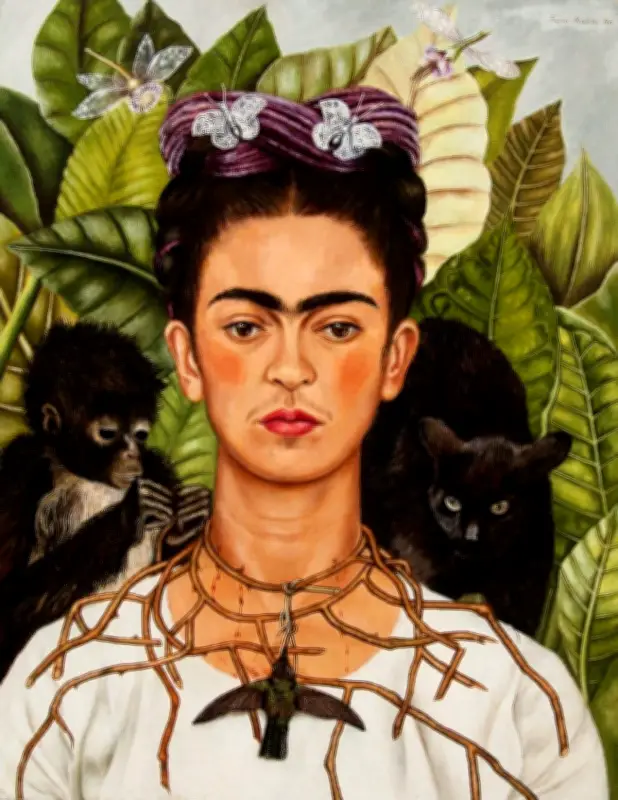
Tate Modern’s latest exhibition, Frida: The Making of an Icon, has sold more advance tickets than any other show in the gallery’s 128-year history, underscoring the enduring global fascination with the Mexican artist. Running into the new year, the exhibition explores how Frida Kahlo became one of the 20th century’s most recognisable figures—a painter, fashion muse, feminist icon and commercial brand.
Early Galleries Highlight Kahlo’s Art
The exhibition’s strongest rooms are the first few, which bring together the majority of the 23 paintings and 11 works on paper by Kahlo. Moving from early self-portraits to landscapes and still lifes, these galleries examine themes that defined her practice: death and dreaming, Mexican nationalism, her fraught relationship with muralist Diego Rivera, her ambivalent attitude toward the United States, Surrealist associations, and her divided sense of self.
These works are accompanied by photographs, jewellery, Indigenous Mexican clothing from Kahlo’s wardrobe, and an excerpt from a film by Nikolas Muray capturing a tender moment between Frida and Diego. In one corner, a black-and-white photograph shows Kahlo painting from her bed using a specially designed easel that suspended the canvas above her, allowing her to work while recovering from injuries sustained in a near-fatal bus accident.

Frames and Personal Details
The frames themselves are noteworthy. A tiny painting scarcely larger than a matchbox sits inside a handcrafted Oaxacan tin frame, while a composite portrait of Kahlo and Rivera is enclosed within a border adorned with clam shells Kahlo collected in Veracruz.
From here, the exhibition broadens into an account of Kahlo’s afterlife. Her work is placed in dialogue with modern and contemporary artists influenced by her imagery, politics and self-fashioning. The Chicana/o movement’s embrace of Kahlo is explored, and her impact on generations of women artists is traced through themes of identity, gender and self-representation.
Fridamania and Commercialisation
The final galleries chart the rise of ‘Fridamania’: shrines, sacred hearts and handcrafted tributes that transformed Kahlo from artist into folk hero and then into a global brand. Glass cabinets are filled with Crocs, socks, lip balms and egg cups bearing Kahlo’s likeness. The line between exhibition and gift shop becomes blurred.
Madonna, one of Kahlo’s more prominent collectors, owns My Birth (1932), in which the artist depicts herself emerging from her mother’s body. ‘If somebody doesn’t like this painting,’ Madonna said in 1990, ‘then I know they can’t be my friend.’ However, Madonna declined to lend the work to Tate for this show, leaving a notable gap.
Missing Masterpieces
Also absent are several of Kahlo’s most recognisable works: The Broken Column (1944), painted after spinal surgery; The Two Fridas (1939), a meditation on identity and heartbreak; and Self-Portrait with Cropped Hair (1940), made shortly after her divorce from Rivera. For megafans, these omissions are felt, especially compared to Tate’s 2005 retrospective, which included more iconic works, including two from Madonna’s collection.
Despite these absences, the exhibition is expected to draw large crowds. Visitors are advised to avoid peak times to fully appreciate the smaller works, such as the matchbox-sized painting. The exhibition runs at Tate Modern until the new year.