

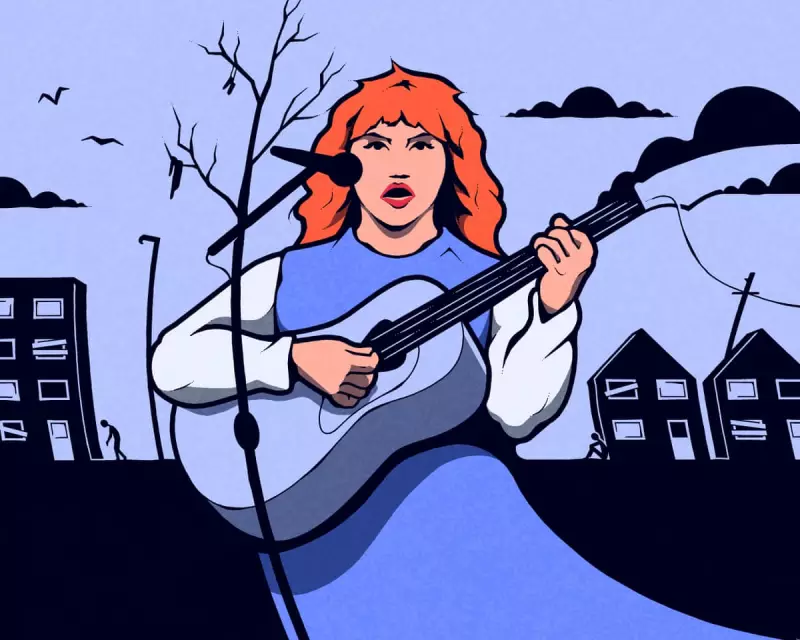
The experience of living through 2025, for many, has been defined by a potent cocktail of global horror, relentless financial pressure, and the corrosive absurdity of online life. Against this backdrop, the year's most resonant artistic statement has arrived not from a politician or a filmmaker, but from an Irish musician. Ciara Mary-Alice Thompson, known as CMAT, has released her third album, 'Euro-Country', a record that brilliantly soundtracks the contemporary condition.
A Sonic Mirror to Modern Malaise
CMAT, the 29-year-old from Dunboyne in County Meath, has created an album that acts as a lightning rod for the times. As she herself has stated, every song touches on the emotional fallout of growing up in this specific era of late capitalism. The record paints vivid portraits of loneliness and alienation, yet it is underpinned by a aching, defiant sense of shared humanity. It is a work that stares unflinchingly at a bleak social landscape while insisting on the possibility of something better.
This thematic depth complements her established reputation as a flamboyant and captivating live performer, witnessed by tens of thousands at festivals like Glastonbury this summer. While her songs often explore classic matters of the heart, the core of 'Euro-Country' is its engagement with the socio-political climate, making CMAT one of 2025's most vital musical voices.

From Irish Ghost Estates to Motorway Rage
The album's lens is often sharply focused on Ireland, serving as a microcosm for wider Western ills. The cover art, featuring Thompson emerging from a fountain at a retail park near her hometown, visually nods to her critique of an environment increasingly dominated by "shopping centres and cement and roads." She sings of a place where dwindling social services have left a vacuum, filled by social media scrolling and far-right radicalisation.
The title track, 'Euro-Country', tackles the legacy of Ireland's property crash head-on. It references the "ghost estates"—empty housing developments built during the Celtic Tiger boom that still scar the landscape. One particularly stark line addresses the human cost: "I was 12 when the das [dads] started killing themselves all around me." This direct engagement with national trauma gives the album a powerful, specific gravity.
Elsewhere, the song 'The Jamie Oliver Petrol Station' masterfully captures the bizarre, accelerated nature of 21st-century life. It depicts a seemingly trivial incident—pulling into a motorway service station branded with the celebrity chef's name—spiralling into an inexplicable fury. Critic Dorian Lynskey called it a quintessential study in "the tragicomedy of misdirected anger," where personal rage simmers, often primed for an online post, while the larger systemic issues of housing, jobs, and security grind on in the background.
An Antidote to Disconnection
The British Association for Counselling and Psychotherapy noted in September that many young people are "surviving, not thriving," feeling disconnected and pessimistic. CMAT's 'Euro-Country' speaks directly to this generation, those who came of age after the 2008 crash into a world remade by the internet. Tracks like 'Iceberg' explore how financial and personal insecurity can break a person, while 'Take a Sexy Picture of Me' offers a bracing look at the modern male gaze.
Ultimately, the album's power lies in its balance of clear-eyed critique and embodied hope. In the tradition of great protest art, it crystallises its time while inspirationally taking a stand against it. In a year fraught with conflict and cynicism, CMAT has delivered a record that carries a very human, and desperately needed, sense of defiant hope. It is not just a collection of songs, but a vital document of what it means to be alive now.






