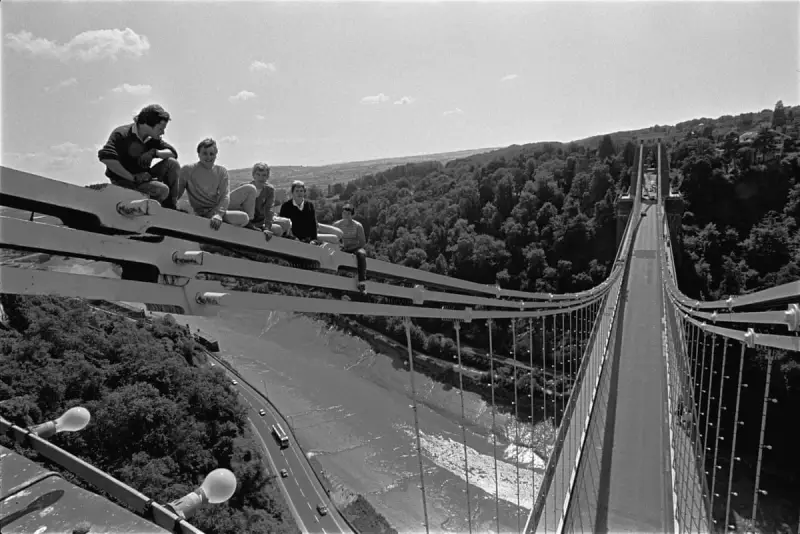
In the mid-1980s, a photograph was taken on Bristol's iconic Clifton Suspension Bridge that perfectly encapsulates a bygone era of work and attitude. The image, captured by local photographer Beezer, shows a group of maintenance workers nonchalantly perched high on the bridge's chains, changing lightbulbs without a harness or hard hat in sight.
A Daring Invitation and a Vertigo-Inducing Climb
The shot was taken for a feature in the Bristol magazine Venue, titled 'Life on the Bridge'. Beezer had gone to document the bridge and its toll keeper, but found a team carrying out maintenance. "They said: 'Do you want to come up and take a shot of us?' Of course I said: 'Yeah!'" he recalls.
His ascent was not for the faint-hearted. He climbed a ladder at the side of the bridge to the middle of one of the towers, switched to another ladder, and then had to make a small jump across a half-metre gap to a 150-year-old wooden floor inside the turret. Below him, cars looked like matchboxes and people like pinheads. One worker accompanied him, while the rest walked up the suspension chains from the middle of the span.

'Hurry Up, Beez!': Capturing a Moment of Reckless Trust
As Beezer fought his vertigo, the workers positioned themselves on the chain. "I have outtakes of them all standing up – there's no safety equipment and they're not hanging on to anything," he says. The men were impatient for their lunch break, urging him: "Is this all right? Hurry up, Beez!"
Beezer reflects that the culture of the time was starkly different. "Perhaps if the mayor or someone had been visiting they'd have worn harnesses, I don't know." The image, now 40 years old, shows a level of casual risk-taking that seems almost unimaginable today. He notes that one of the men in the photo only retired last year.
A Lasting Legacy of a Bristol Insider
The photograph became one of Beezer's most popular, bought by the bridge's trust and seen in restaurants across Bristol. He is unsure if it caused the workers any trouble, but its enduring appeal is clear. Beezer, who began his career documenting Bristol's punk and reggae scenes from an insider's perspective, sees his work as a form of history. His new volumes are titled Until Now: A Life in Photographs.
He offers advice born of his long career:
- Try to get that one image that sums it all up.
- Use your camera to get deep within your scene.
- Print a picture instead of sending data.
Looking back, Beezer is certain: "What with health and safety, a shot like that wouldn't happen today." The photograph stands as a testament to a specific moment in Bristol's social and industrial history, a frozen second of daring that has long since passed into legend.