As the calendar turned to 1 January 2026, readers of The Guardian were presented with a compelling and thought-provoking piece of visual commentary. The newspaper's renowned 'Picture' section, dedicated to powerful editorial imagery, featured a single, resonant illustration that framed the year ahead not with words, but with a potent visual metaphor.
A Fork in the Road for the New Year
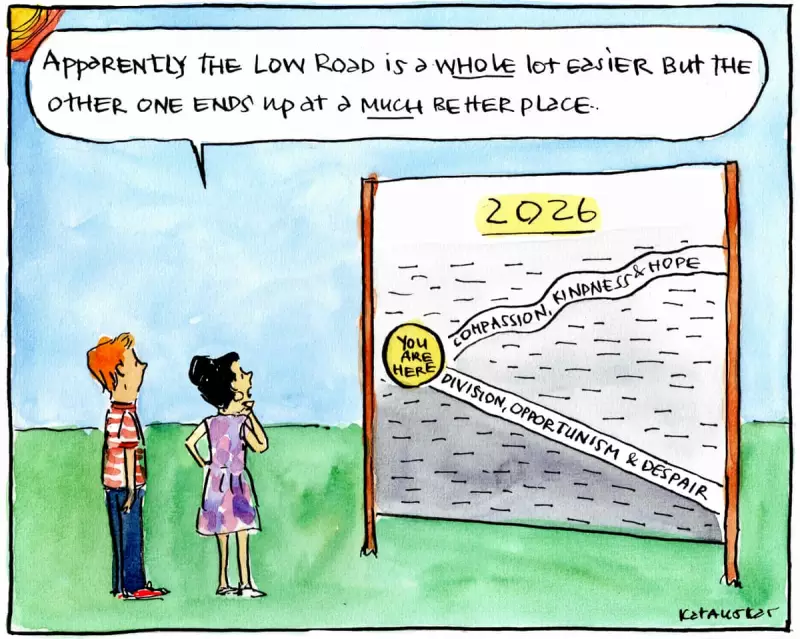
The image, published on the first day of the year, serves as a symbolic starting point for 2026. It depicts a classic fork in the road, a timeless representation of choice and consequence. This is not a simple rural path, however; the artistic treatment and context suggest the roads represent broader societal, political, or environmental directions. The artwork challenges the viewer to consider which route we, collectively and individually, will choose to travel in the coming twelve months.
The decision to lead with this visual on New Year's Day is significant. It moves beyond traditional textual predictions or resolutions, using the universal language of imagery to pose a fundamental question about the future. The 1 January 2026 publication date marks it as a foundational piece of commentary for the year, setting a reflective and questioning tone from the very outset.

The Power of Visual Metaphor in Journalism
The Guardian's 'Picture' section has long been a space for editorial cartoons and photojournalism that pack a conceptual punch. This entry continues that tradition, relying on the strength of its metaphor to communicate complex ideas about destiny, decision-making, and responsibility. The absence of a lengthy explanatory article places the onus of interpretation on the audience, making the engagement with the piece active rather than passive.
By presenting this fork in the road, the illustration implicitly references the major issues of our time. It could be seen as alluding to the climate crisis, political polarisation, technological advancement, or social justice. The undefined nature of the paths is their core strength, allowing each viewer to project the most pressing choices of the era onto the canvas of the new year.
The artwork stands as a silent call to action. It does not preach a specific direction but insists that a choice is imminent and necessary. In this way, it functions as a piece of democratic commentary, inviting public reflection on the trajectory of society as we step into 2026.
Setting the Agenda for a Year of Decision
Publishing such a piece on New Year's Day is a deliberate editorial strategy. It frames 2026 not just as another year, but as a period of potential inflection. The visual suggests that the decisions made—or avoided—during this time will have lasting ramifications. It creates a moment of pause amid the celebrations, a visual prompt for introspection about the collective path ahead.
The power of the image lies in its simplicity and universality. The fork in the road is an archetype, instantly understood across cultures. By leveraging this, The Guardian ensures its commentary reaches beyond its regular readership, speaking to anyone concerned with the future. It is a reminder that journalism can provoke and question through art just as effectively as through reportage.
As we move forward from that symbolic January date, the image's question lingers. The best path to take in 2026 remains undefined, a personal and collective puzzle to be solved through the actions, policies, and conversations of the year to come. The Guardian's first-day illustration serves as a lasting bookmark, a visual thesis against which the events of 2026 will inevitably be measured.