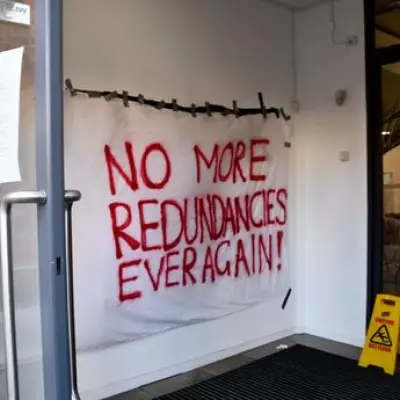
In a powerful act of protest, students at Montclair State University in New Jersey recently gathered for a sombre mock funeral outside their college of humanities and social sciences. Carrying flowers, they stood before a tombstone inscribed with the names of 15 departments, including English, history, and sociology, symbolising what they see as the death of these disciplines at the hands of university administrators.
A Eulogy for Unmonetisable Dreams
Organiser Miranda Kawiecki, a junior, read a poignant eulogy. "I coordinated this demonstration because I have dreams that cannot be monetized," she declared. "I have a problem with our society that cannot be solved with an algorithm. I have words to write and say that cannot be generated artificially." The demonstration targeted the university's plan to consolidate its departments into four thematic schools, a move critics argue prioritises corporate efficiency over academic integrity.
This scene in New Jersey is not an isolated incident. It reflects a deepening existential crisis for humanities and liberal arts programmes across American higher education. From public state colleges to elite private institutions, restructuring, consolidation, and layoffs are becoming commonplace.

A National Trend of Cuts and Consolidation
The scale of the retrenchment is significant. An analysis by Inside Higher Ed found that more than 9,000 higher education jobs were cut last year alone. The cuts are often guided by corporate-style consulting firms hired to streamline operations.
Specific examples highlight the trend's breadth:
- In Indiana, legislation forced public universities to cut or consolidate roughly 400 academic programmes, many in the humanities.
- The University of Texas at Austin anticipates cuts to ethnic and regional studies.
- The University of North Carolina plans to close six centres for geographical area studies.
- The University of Chicago has paused graduate admissions for nearly all its humanities programmes.
Driving this crisis are twin pressures: long-term disinvestment in public education creating budgetary shortfalls, and political pressure from the right, which escalated under the Trump administration's ideological targeting of federal research funding.
The Clash Over Education's 'Value'
At its core, the conflict reveals a fundamental disagreement about the purpose of a university education. On one side, increasingly corporatised administrations favour market-driven metrics, enrolment figures, and job-placement rates. On the other, defenders of the humanities argue their value to critical thought, ethical reasoning, and democratic society cannot be quantified.
"The humanities simply don't fit a corporate model because they are just not monetizable in the same way," explained Adam Rzepka, an English professor at Montclair State. He contends the attack is also political: "Free thought and rigorous, free inquiry is dangerous to executive power."
University spokespeople, like Montclair State's Andrew Mees, counter that restructuring is a strategic effort to ensure programme vitality amid declining enrolments in specific majors, insisting faculty remain "stewards of the curriculum."
The consultancy model is explicit at Portland State University in Oregon. Facing an $18m deficit, it laid off faculty and hired Gray Decision Intelligence, a firm using AI to analyse "student demand, job market trends, and competitor activity" for its "Pivot" overhaul plan.
While the firm's founder, Bob Atkins, stresses decisions should be "data-informed, not data-driven," faculty fear this process is incompatible with the intangible worth of a liberal arts education. "It's hard to get these things back when they're cut," warned Bill Knight, a Portland State English professor.
Eric Hayot, a Penn State professor, sees a grim endgame: a system where only the elite can access humanistic education, while everyone else is funneled toward vocational training. With public confidence in higher education plummeting, the outcome of this crisis will reshape not only universities but the very skills and values nurtured for future generations.