

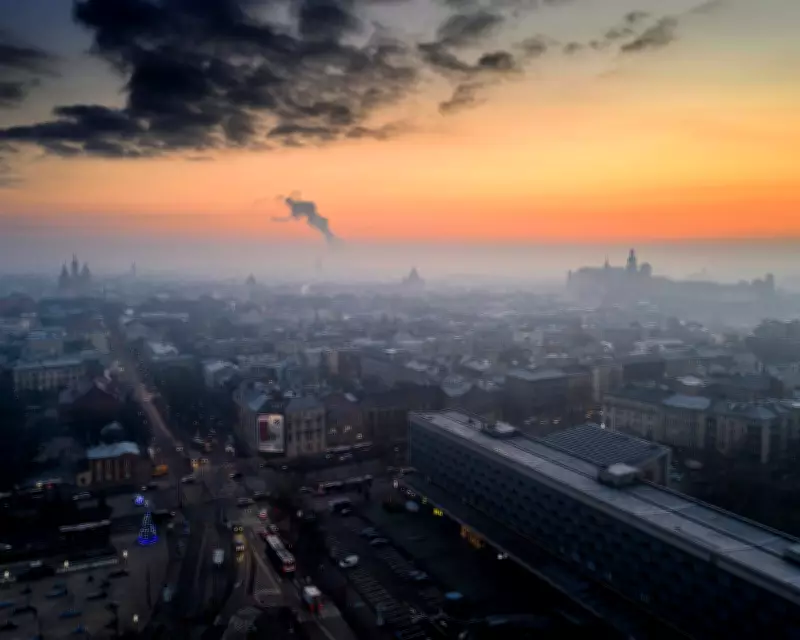
Kraków's Clean Air Revolution: How a Polish City Saved Nearly 6,000 Lives
Kraków, once notorious as the smog capital of Poland, has achieved a remarkable environmental turnaround through decisive political action. A comprehensive ban on burning solid fuels, combined with substantial subsidies for cleaner heating alternatives, has resulted in dramatically improved air quality and significant public health benefits over the past decade.
The Human Cost of Pollution
Marcel Mazur, an allergy specialist at Jagiellonian University Medical College, recalls childhood experiences in Kraków where "so much smoke you could see and smell it" forced him to hold his breath in certain areas. Now treating patients with respiratory difficulties, Mazur understands intimately the damage toxic gases inflict on human health. His research reveals substantial improvements: between 2008 and 2018, cases of asthma in children decreased by 17%, while allergic rhinitis cases dropped by 28%.
Policy Implementation and Results
The city's transformation began in 2013 when authorities announced plans to prohibit coal and wood in home heating systems. This ban took full effect in 2019, by which time tens of thousands of dirty stoves and boilers had been replaced through government-subsidized programs that sometimes covered the entire cost of conversion. The local administration also implemented fuel restrictions in the years leading up to the formal prohibition.

According to exclusive analysis from the European Clean Air Centre, these measures have saved 5,897 lives over ten years through reduced exposure to black carbon—a particularly harmful component of particulate matter. Researchers used established methodologies and data from specialized monitoring stations to calculate these mortality reductions.
Measuring the Progress
Anna Dworakowska, co-founder and director of Polish Smog Alert, highlights the dramatic improvement: "Little more than 10 years ago, we had about 150 days a year with too-high concentrations of particulates in Kraków. Now it's down to 30." The organization, which began in Kraków before expanding nationwide, has been instrumental in pushing for air quality improvements across Poland.
Further progress is anticipated with the recent introduction of a low-emissions zone covering approximately 60% of the city, restricting vehicle access based on pollution standards. In 2024, Kraków recorded no breaches of daily limits for benzo(a)pyrene—a cancer-causing pollutant from wood and coal combustion—for the first time since measurements began.
Political Consensus and Challenges
Łukasz Adamkiewicz, president of the European Clean Air Centre, attributes Kraków's success to unusual political unity: "Green, red, black, right, left, up, down—everyone said 'OK, this is a problem we need to tackle.'" This consensus enabled the implementation of policies that have produced measurable health benefits.
However, significant challenges remain. In late January, Kraków briefly ranked as the world's most-polluted major city according to IQAir's analysis of 120 global urban centers, surpassing even Lahore and Kolkata. This temporary spike highlights the ongoing vulnerability to pollution drifting from surrounding towns and villages where coal and wood remain dominant heating fuels.
Broader Implications and Future Directions
Kraków's experience demonstrates that political will, when combined with public support and practical subsidies, can produce substantial environmental and health improvements. The city's success has inspired similar initiatives across Poland, with citizen pressure and advocacy groups driving adoption of anti-smog measures in other municipalities.
Rachel Huxley, head of mitigation at health charity Wellcome, emphasizes the dual benefits of addressing superpollutants like black carbon: "If we take action to tackle superpollutants, we can have this huge impact on global warming and also on all of these premature health impacts."

While Kraków's air quality has improved significantly, experts stress that continued efforts are necessary—particularly in addressing cross-boundary pollution from surrounding areas. The city's transformation serves as both an inspiration and a practical model for other polluted urban centers in Eastern Europe and beyond, demonstrating that coordinated action can yield measurable improvements in public health and environmental quality.





