

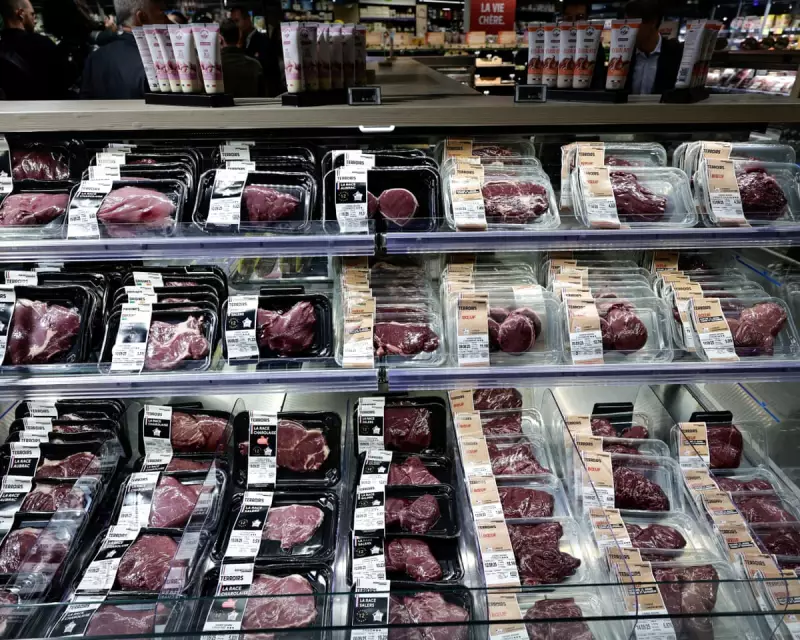
A groundbreaking study has revealed that the European Union's generous tax breaks on meat are shielding consumers from the true environmental cost of their diets, with significant ecological consequences.
The Hidden Subsidy for Meat Consumption
Research from the Potsdam Institute for Climate Impact Research, published in the journal Nature Food, highlights a stark fiscal imbalance. While animal-based products are responsible for the largest share of the EU's diet-related ecological damage, they are largely exempt from standard Value-Added Tax (VAT) rates.
Twenty-two of the EU's 27 member states apply a reduced VAT rate to meat purchases. This creates a price signal that fails to reflect the substantial environmental and social costs linked to production, including greenhouse gas emissions, biodiversity loss, and pollution.

The tax break is most pronounced in Ireland, where fresh meat is taxed at 0%, compared to the general VAT rate of 23%. Significant gaps also exist in Croatia (20 percentage points), France (15 points), Germany and Italy (12 points), and Spain (11 points). Only Bulgaria, Denmark, Estonia, Latvia, and Lithuania tax meat at the full standard rate.
Modest Cost for Major Environmental Gain
The study modelled the impact of two potential policy reforms: applying the full standard VAT rate to meat, or introducing a carbon price on food products. The findings suggest that relatively small financial adjustments could yield substantial environmental benefits.
Ending the VAT privilege for meat across the EU would increase the average household's annual food expenditure by €109. However, if the generated tax revenues were redistributed to citizens, the net cost could drop to as little as €26 per household per year.
In return, this change could reduce the environmental footprint of EU food consumption by between 3.48% and 5.7%. For climate impact alone, it would cut greenhouse gas emissions by approximately 29.9 megatons of CO2 equivalent annually—roughly 5% of the total from household diets.
A More Effective but Complex Alternative
The research indicates that a carbon pricing model set at €52 per ton of CO2 equivalent for food could be even more effective environmentally and cheaper for consumers, bringing net household costs down to about €12 per year.
However, the study's authors, including lead researcher Charlotte Plinke, acknowledge that such a system requires more complex economic and political calculations. Removing the existing VAT break on meat is therefore presented as a simpler and more feasible first step.
"Our numbers show the policies we investigated can be effective, but they also reveal that we do not yet fully price in the environmental impacts of meat," Plinke stated. "It’s important to have exact information of what the impacts actually are, and then to be transparent about the goals of the policy and the use of revenues."
The study underscores that, in both policy scenarios, society would be better off once the costs of mitigating environmental destruction are factored into the price of food, moving towards a system where the polluter truly pays.






