

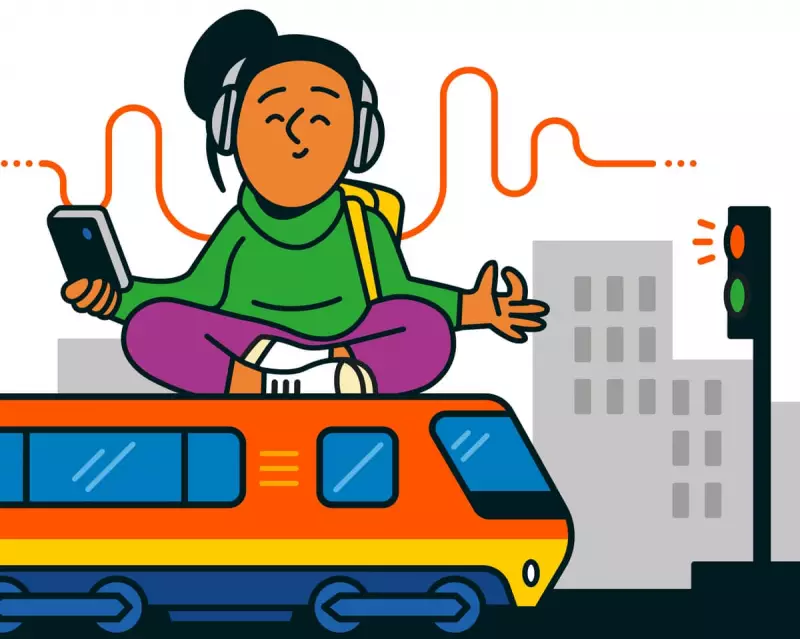
For countless workers across the UK, the daily journey to and from the office is a source of dread, often involving packed public transport or congested roads. This daily grind is more than just an inconvenience; it can significantly heighten stress levels, cut into valuable exercise time, and lead to unhealthy snacking. However, experts argue that with a shift in perspective and some clever planning, this 'lost' time can be reclaimed for personal growth, fitness, and even joy.
Conduct a Commute Audit and Reclaim Your Time
The first step towards a better commute is understanding its true cost, advises Kelly Nolan, a time management coach and former lawyer. She recommends performing a 'commute audit' by visually blocking out travel time on your calendar. "Creating a visual representation of how much commuting takes out of your day gives an accurate picture," Nolan explains. "It’s not just about free time; it’s about seeing how it affects other activities." The goal isn't to despair but to identify opportunities within that fixed schedule.
The Power of Habit Stacking on the Move
One of the most effective strategies is habit stacking—attaching a new, desirable activity to your existing commute routine. Since you're already making the journey, piggybacking another task makes it far more likely to stick. With the average UK commute at 27 minutes (rising to 38 minutes in London), this amounts to roughly five hours of potential 'me time' each week for daily commuters.

This time can be used for:
- Fitness: Cycling, walking part of the route, or running home.
- Learning: Using apps to study a new language or listen to educational podcasts.
- Creativity & Work: Brainstorming projects, writing, or tackling admin tasks.
- Mindfulness: Meditating or listening to calming audio to de-stress.
- Connection: Catching up with friends or family via phone calls.
Nolan highlights that commuting offers a structured, regular window for focused work, referencing Cal Newport's concept of "Deep Work." "If you’re stuck on a bus, rather than scrolling, you could use the time to brainstorm a specific idea," she says, noting that quiet, still moments are often when our best ideas surface.
Managing the Inevitable Frustrations
But what about delayed trains or standing in unpleasant conditions? Gordon McCrorie, a life coach based in Glasgow, advocates for the power of acceptance. "A lot of life’s emotional friction comes when what we would like life to be is not matched by reality," he states. His advice is to distinguish between what you can and cannot control, and to avoid dramatic, negative language. "Think data, not drama," McCrorie suggests. "This train is 15 minutes late. Can I change that? No. So, I'll settle and enjoy the extra podcast time."
For the journey home, establishing a clear ritual is key to signalling to your brain that work is over. Nolan recommends fun audiobooks, comedy podcasts, or a specific playlist. This helps create vital psychological boundaries, especially for those who struggle to switch off.
The New Challenge: Creating a 'Faux Commute' for Hybrid Workers
The rise of hybrid and home working presents a new dilemma: the loss of the natural transition between home and office life. Both experts agree that inventing a short, deliberate 'faux commute' can be hugely beneficial. McCrorie, who bookends his home-working days with dog walks, emphasises that movement is a proven way to reduce anxiety. "Even something as simple as stretching for a few minutes can regulate the nervous system," he notes.
Not everyone needs to go outside, however. For some, a simple ritual like changing into a specific pair of 'work slippers' or opening and closing a dedicated office door can provide enough of a boundary. The core principle is intentionality—consciously designing routines that separate professional and personal time, turning a daily chore into an opportunity for a better, healthier day.






