On a crisp winter's day in Northamptonshire, the heart of Old Sulehay Forest holds a living relic. Here, a multi-stemmed small-leaved lime tree, its gnarled base cloaked in moss and feathered with new growth, stands as a silent witness to five centuries of history. Shaped by the ancient practice of coppicing, its vast canopy stretches nearly 20 metres wide, a testament to its enduring presence.
The Quiet Phenomenon of Crown Shyness
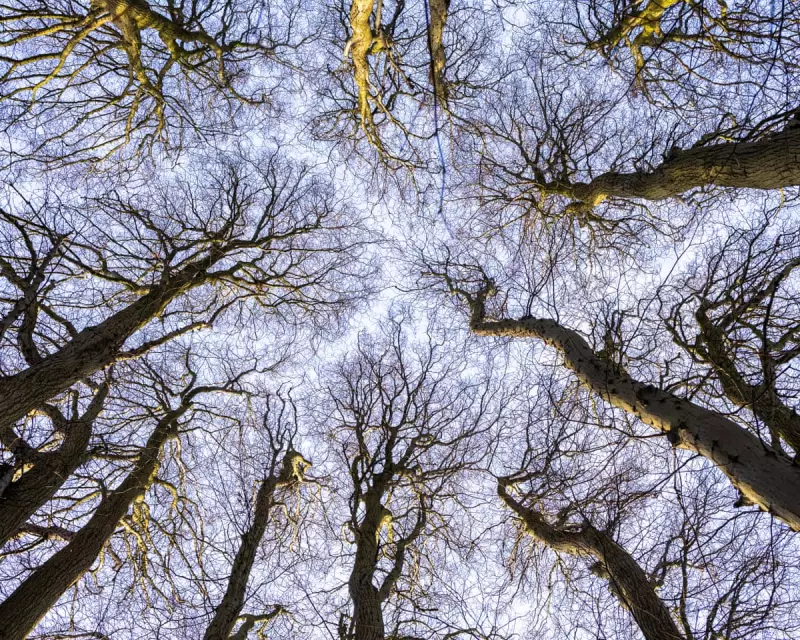
Looking up into the intricate lattice of branches, a fascinating botanical behaviour is on display. Each tree crown maintains a precise boundary, its leaves and twigs halting just before touching its neighbours. This delicate spacing is known as crown shyness, a phenomenon that creates a pattern of channels and gaps in the canopy. In the profound quiet of the woodland, broken only by distant church bells and a robin's winter song, this respectful distance between trees feels perfectly apt.
Echoes of an Ancient Craft
This ancient lime is a physical archive of a lost way of life. For centuries, woodsmen practised coppicing here, cutting trees like this lime, oak, ash, and hazel near the ground to encourage straight, rapid regrowth. The technique bound communities to the forest, providing essential materials. The fine-grained lime wood was prized for carving, while the strong inner bark, or bast, was processed to make rope and cordage.

John Clare's poetry hints at the soundscape that once filled these woods: the chatter of workers and the ring of axes. Today, that industry is silent, though the craft of processing lime bast has seen a recent revival in a nearby wood, reconnecting people with this arboreal heritage.
A Hopeful Sign in a Changing Climate
Pollen records reveal a startling history: around 6,000 years ago, the small-leaved lime was one of Britain's most abundant trees. Its decline has confined it largely to fragments of ancient woodland like Old Sulehay, with its seeds often struggling to germinate without consistently hot summers.
Yet, there is a glimmer of hope. In recent years, naturalists have observed increasing numbers of lime seedlings carpeting the forest floor in local woods. This unexpected regeneration offers a small but significant sign that this charismatic native tree, with its shy canopy and historical importance, may yet find new opportunities to thrive as Britain's climate continues to evolve.