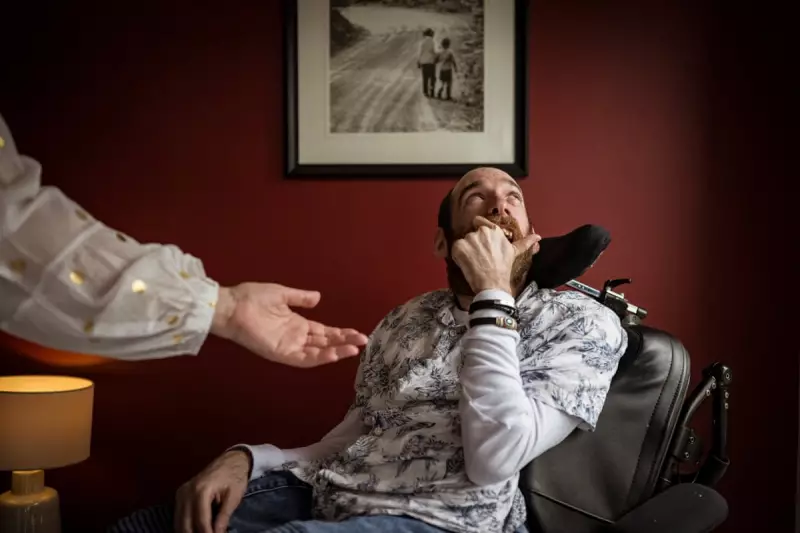
A man with complex disabilities has successfully fought a drastic funding cut to his National Disability Insurance Scheme (NDIS) package, but fears new government rules will prevent others from accessing the same lifeline.
A fight for life and independence
Scott Clough, 47, lives with cerebral palsy, quadriplegia, epilepsy, is blind and non-verbal. Since late 2019, his NDIS funding has allowed him to live with his sister and primary carer, Julienne Verhagen, with round-the-clock support. This arrangement kept him out of a supported independent living facility, where Verhagen says he previously experienced both good care and serious neglect.
In 2023, this stability was shattered when Clough received a new NDIS plan that slashed his annual funding by roughly 50%, from about $835,000 to $415,000. The cut effectively meant he could no longer afford the 1:1 support that enabled him to live with his sister, forcing a potential return to group home accommodation.

"I told him, 'over my dead body'," Verhagen said, convinced such a move would lead to her brother's death. After internal NDIS appeals were rejected, she turned to the Administrative Review Tribunal (ART), the independent body that acts as a final avenue for disputing NDIA decisions.
A costly two-year tribunal battle
The legal fight took two years and cost approximately $24,000 in fees. In November 2025, it concluded with a decisive victory. The tribunal overturned the NDIA's decision, and Clough was granted a new plan worth $1.28 million per year—triple the amount he had been appealing against. The plan reinstated his 1:1 support, overnight carers, and essential therapies.
"As flawed as the ART process is… it was the only choice we had, and he would not be alive today without it," Verhagen stated.
Clough's case is not isolated. Data shows a sharp rise in NDIS-related cases going to the tribunal. In the year to June 2025, the ART reported 7,935 new NDIS cases, a 95% increase. Crucially, the tribunal overturned the NDIA's original decision in 73% of cases in the eight months to June 2025, a far higher overturn rate than in other areas like migration or taxation it oversees.
New system threatens appeal rights
Now, Clough and his sister fear for others in the disability community. A major NDIS overhaul, known as New Framework Planning, is set to drastically reduce the tribunal's power from mid-2026.
Under the new system, support plans will be generated by a computer program, with NDIS staff having no discretion to amend them—a process critics label "robo-planning." More significantly, if participants appeal, the ART will reportedly lose its authority to alter a person's plan or reinstate funding. Instead, it would only be able to send the plan back to be recalculated by the same automated tool.
Legal experts have issued stark warnings. Belinda Kochanowska of Intrepidus Law called it a "catastrophic" change, creating a "loop-de-loop appeal right" that offers no real remedy. Naomi Anderson from Villamanta Disability Rights Legal Service agreed, stating, "The tribunal is the independent arbiter… We're about to lose that."
At a Senate estimates hearing in December, NDIA deputy CEO Matthew Swainson confirmed the ART would no longer have the power to change the total amount of NDIS funding a person receives—the very action that saved Clough's care package.
The NDIA has stated that "rules" governing the new system are still being developed with the disability sector and states, with public consultation slated for early 2026. Advocates like Anderson hold a faint hope that safeguards, such as a human-led risk assessment, might still be included. "I would hope… that if the machine gets it completely wrong, there is a human being who can do something," she said.
For Scott Clough, who communicates by tapping his hand against his sister's, the concern is palpable. When asked if he was worried for others facing a system without proper checks and balances, his response was a repeated, urgent tap.