

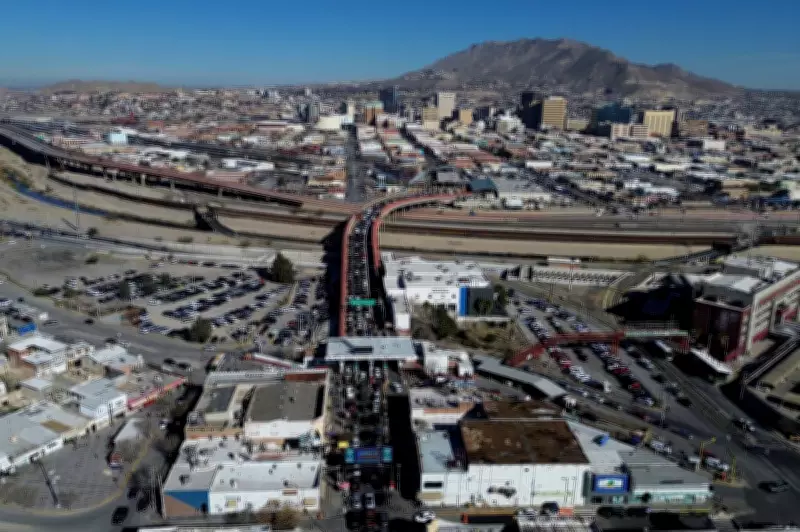
Cartel Drone Incursions at US-Mexico Border Ignite Security Crisis
Alleged incursions by Mexican cartel drones into US airspace, coupled with the sudden closure of El Paso's airspace, have thrust the sophisticated weaponry of organized crime groups into the spotlight. Conflicting reports emerged on Wednesday regarding whether the shutdown resulted from cartel drone activity or a dispute over Pentagon counter-drone technology testing. However, experts emphasize that drug gangs' use of drones along the border has become increasingly prevalent and alarming.
Escalating Arsenal of Mexican Cartels
As Mexican cartels amass greater wealth and power, their arsenals have evolved dramatically. Gone are the days of simple pistols and rifles; today, traffickers and hitmen deploy drones capable of dropping bombs, improvised explosive devices, armored vehicles, landmines, and grenade launchers. "The cartels are preparing for war," declared Eduardo Guerrero, a prominent Mexican security analyst. "They possess substantial financial resources and the ability to import state-of-the-art weaponry into Mexico, often surpassing the capabilities of local authorities who face bureaucratic hurdles."
Veronica Escobar, a Democratic congresswoman representing El Paso, noted that drone forays from Mexico are "nothing new," with incidents dating back to the inception of drone technology. This sentiment underscores a persistent and growing threat that has now captured national attention.

Drones: A Game-Changer in Cartel Warfare
Drones have become a cornerstone of cartel operations, first weaponized in 2017 and now used for reconnaissance, drug delivery, and increasingly, to bomb rivals and terrorize rural communities. Vanda Felbab-Brown, an expert on non-state armed groups at the Brookings Institution, highlighted severe tactics: "We have witnessed cartels conducting carpet bombings in areas like Michoacán state, displacing tens of thousands through scorched-earth policies implemented via drones." This capability allows crime groups to wage warfare over greater distances, fundamentally altering the dynamics of border security.
Steven Willoughby, director of the counter-drone program at the US Department of Homeland Security, testified before Congress, revealing that cartels use drones nearly daily for surveillance and drug smuggling across the border. In the latter half of 2024, over 27,000 drones were detected within 500 meters of the southern border, with one seizure in October involving a drone carrying 3.6 pounds of fentanyl pills.
Political Tensions and Denials
Mexican President Claudia Sheinbaum has consistently disputed these allegations, asserting during a news conference that "there is no information on any new drones currently at the border" and urging US agencies to share any evidence with Mexican authorities. Despite these denials, the incident has fueled political tensions, with Guerrero warning that any cartel drone strike on US soil could provide a pretext for the Trump administration to launch a ground offensive against Mexico, a threat long looming over bilateral relations.
This situation highlights a critical juncture in US-Mexico security cooperation, as advanced cartel weaponry challenges traditional enforcement methods and raises the stakes for cross-border conflict.






