

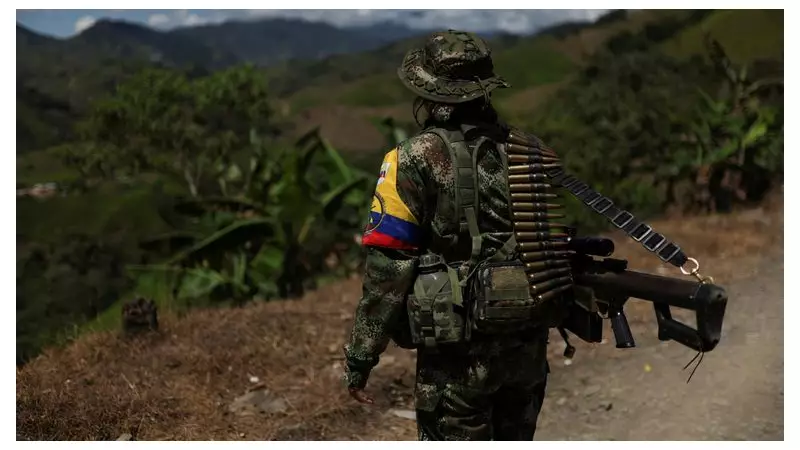
The commander of the largest dissident faction of Colombia's former FARC guerrilla army has issued a rallying cry for rebel groups to unite against potential United States intervention, escalating fears of renewed conflict in the region.
A Call to Arms Amidst Trump's Threats
Nestor Gregorio Lozada, known by his alias 'Ivan Mordisco', made the appeal in a video message. He stated that a collective front was necessary to counter any US military action in Colombia. This call followed provocative remarks from former US President Donald Trump, who responded to a question about ordering US military action against Colombia by saying it 'sounds good to me'.
Trump also personally attacked Colombia's left-wing President, Gustavo Petro, labelling him a 'sick man who likes making cocaine and selling it to the United States'. These comments caused significant alarm in Bogotá, coming after a US incursion in neighbouring Venezuela that resulted in President Nicolas Maduro's capture.

The Fragile Peace and a Resurgent Threat
Colombia's history is scarred by more than 50 years of armed conflict between the state and various rebel groups, primarily the Revolutionary Armed Forces of Colombia (FARC). A landmark but highly contested peace agreement was finally signed in 2016 under then-President Juan Manuel Santos.
However, the peace remains fragile. Sporadic fighting continues in rural areas between the Colombian army and splinter groups who rejected the deal. Carlos Ruiz Massieu, the UN's special representative in Colombia, has warned of resurging violence, noting that armed actors are exploiting limited state presence to control illicit economies.
Why Colombia is Not Venezuela
Despite the parallels drawn with Venezuela, the military dynamic is fundamentally different. As explained by Sky News' senior foreign producer Dominique van Heerden, the US military has a strong, long-standing partnership with the Colombian armed forces, a relationship that has endured despite political changes.
This contrasts sharply with the near-non-existent US working relationship with the Venezuelan military. Furthermore, while the Venezuelan military has been accused of facilitating cocaine trafficking, the Colombian military actively battles to stem cocaine production, albeit facing immense challenges.
The situation presents a complex dilemma for Washington. Any potential operation would likely target the very armed groups opposing the Colombian state, not the state itself. Meanwhile, President Petro, a former rebel fighter elected in 2022 on a 'total peace' platform, faces the monumental task of ending a conflict that has claimed over 450,000 lives while navigating incendiary international rhetoric.






