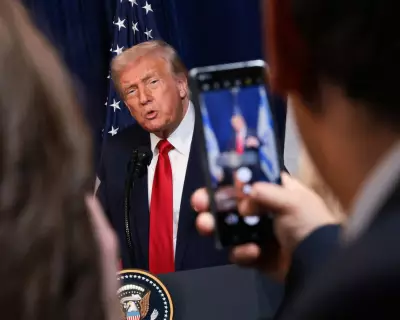
In a moment that could have defined a presidency, Donald Trump addressed the world from the opulent surroundings of his Mar-a-Lago club in Palm Beach, Florida, on Saturday, 3 January. The subject was a significant foreign policy victory: the audacious overnight operation by US forces that toppled Venezuelan dictator Nicolás Maduro.
A Churchillian Moment Lost to Petty Grievances
Dressed in a dark suit, white shirt, and blue tie, the president sought to project gravitas, praising the "derring-do" of American military heroes. He outlined vague plans for the US to effectively "run" Venezuela in the aftermath. Yet, the potential for a historic, focused address swiftly unravelled as Trump returned to a familiar script of personal and political grievances.
From discussing Maduro's "savage and murderous gangs," Trump's train of thought rapidly derailed, jumping to crime in Washington DC, the role of the National Guard, and then to cities like Chicago, Memphis, and New Orleans. He lamented uncooperative governors and mayors, claiming, "We did a great job. Got no credit for it whatsoever."
Settling Scores Amid Global Scrutiny
With the future of Latin America in the balance, the president used the platform to settle old scores. He contrasted current military leaders, like Joint Chiefs Chair Gen Dan "Raizin" Caine—whose name he finds fascinating—with generals from his past whom he "didn't like" and "didn't respect." When questioned about failing to inform Congress of the operation, he cited their tendency to leak information.
The press conference also saw Trump defend his controversial pardon of convicted Honduran drug trafficker and former president Juan Orlando Hernández. He justified it by comparing Hernández's treatment to how the "Biden administration treated a man named Trump," asserting it was unfair persecution.
The Biden Obsession and a Thin-Skinned Finale
Trump repeatedly circled back to his predecessor, mentioning Joe Biden half a dozen times. He blamed the Ukraine war squarely on Biden, stating, "If I were president, it would have never happened," and claimed a Biden election win would have turned the US into "Venezuela on steroids."
The event underscored a defining paradox of the Trump presidency. He had orchestrated a major geopolitical event that commanded global attention, yet remained fixated on perceived slights and eager for credit. The image of the world's most powerful man, holding court at his gilded resort, was undercut by a peevish focus on past injustices. As one report noted, his delicate skin—literally prone to bleeding from a minor nick—mirrored a remarkably thin-skinned political persona, even in his moment of triumph.