

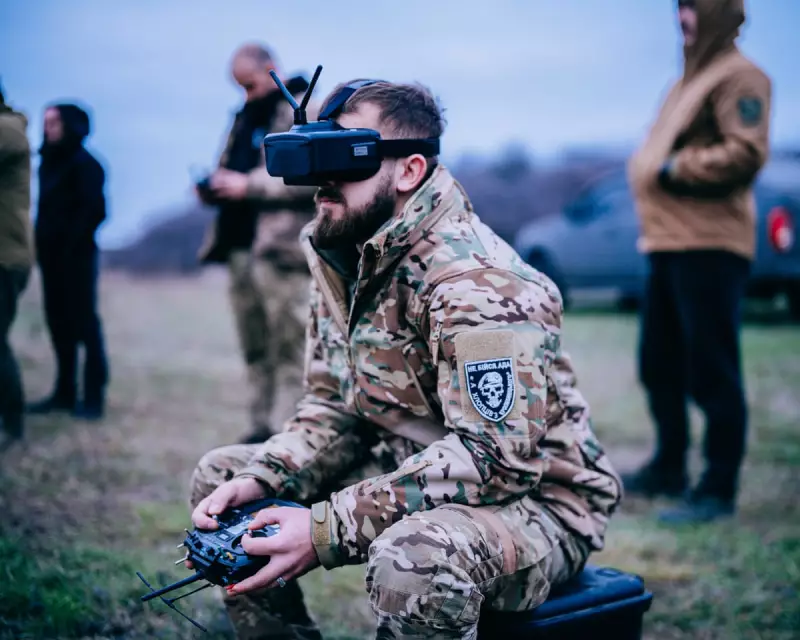
On a hot and increasingly precarious section of the Ukrainian frontline, drone operators are engaged in a relentless battle of attrition, wondering how long they can sustain the intense pressure required to hold the line.
The Digital Battlefield in a Wooden Bunker
In a bunker reinforced with wooden logs, Dmytro, 33, monitors a dozen live video feeds from the front. He is part of the 423rd unmanned systems battalion, a specialist drone unit formed only in 2024. Using Ukraine's battlefield Delta system, he cycles through grainy footage from one-way FPV (First Person View) drones, clearer imagery from commercial Mavics, and data from bomber drones.
The terrain he watches over is distinct from other sectors. This is not the defendable urban landscape of Donetsk, but flat farmland in the meeting point of Dnipropetrovsk and Zaporizhzhia oblasts, dotted with destroyed villages. "There are a lot of fields and if we lose a height advantage, we have to retreat for kilometres," observes his commander, Captain Kostya.

A Vulnerable Front and Relentless Russian Pressure
It was near here, east of Huliaipole and roughly 50 miles from Zaporizhzhia city, that the Ukrainian line yielded last November. An opportunistic Russian attack overwhelmed the war-weary 102nd territorial defence brigade, resulting in the loss of about six miles of territory.
Military analyst Serhii Kuzan explains that Ukraine's intense defence further east around Pokrovsk had exhausted reserves, creating a vulnerability Russia exploited. The situation was only stabilised by redeploying the 225th assault regiment by the end of the month.
Despite the extraordinary reconnaissance ability of Ukrainian Mavic drones, Russian forces have used late autumn fog to mask their movements, combining it with devastating 250kg glide-bomb strikes launched from jets operating safely beyond Ukrainian air defence range.
The Human Cost and the Question of Endurance
When visibility is clear, the drone crews work unceasingly. Pilots like Maksym, 29, and Serhii, 24, work in mixed crews, flying missions from frontline positions. Rest is fleeting. "You can always have enough [time] to sleep 15 minutes and you are OK," Maksym claims.
The psychological toll is part of the job. Maksym recalls a recent "good day" where his crew killed seven Russian soldiers and wounded three. "We feel joy because you killed your enemy," he states bluntly.
The statistics are stark. The 423rd battalion alone reported killing 418 Russian soldiers in November. British estimates suggest Russia suffered around 1,033 casualties a day that month. Ukraine's commander-in-chief, Oleksandr Syrskyi, says drones now account for 60% of Russian casualties, with Ukrainian pilots flying 10,000 combat missions daily in November.
Commander Vitaliy Hersak of the 423rd battalion underscores the challenge: Russia appears to have "infinite numbers" while Ukraine is "basically out of infantry". Farther east, pilots from the Da Vinci Wolves battalion question their own endurance. "I think I could do it for another six months, that's it," says one, despite the war likely lasting longer.
New recruits like Sasha, 23 (call sign 'Lego'), are learning to fly FPV drones to fill the ranks. He signed up three months ago, driven by the realisation that "I can't sit and do nothing and just live". For him and many others, the immediate goal is simple: "the first thing is just survive".






