

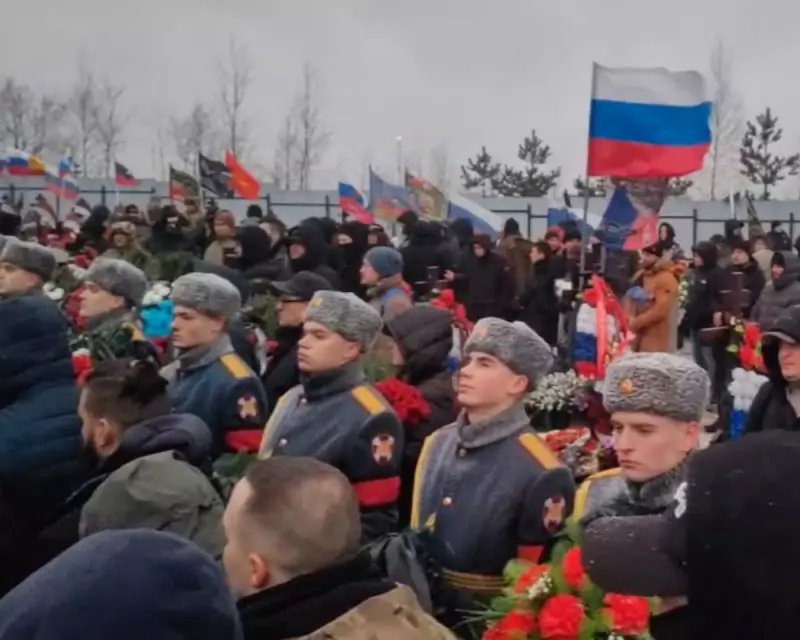
Hundreds of mourners packed into Moscow's Cathedral of Christ the Saviour on Monday, gathering beneath its golden icons for a funeral that blended street-level militancy with high Orthodox ritual. They were there to bid farewell to Stanislav Orlov, the founder of the far-right Russian paramilitary unit known as Española.
A Funeral Shrouded in Silence
The service, held in a space typically reserved for state ceremony, was marked by solemn prayers and chants of "One for all, and all for one." Yet a critical detail was missing: any official explanation for Orlov's death. The silence amplified weeks of intense speculation that began when rumours of his killing emerged online on 9 December.
Reports from both Kremlin-linked and independent Russian media soon suggested Orlov, known by his callsign "Spaniard," was not killed on the Ukrainian frontlines. Instead, he was allegedly ambushed and shot at his home in Russian-annexed Crimea by Moscow's own security services.

On the day of the funeral, the exile-run outlet Astra published CCTV footage it claimed showed the moments before the killing. The video depicted armed Russian servicemen arriving at Orlov's house, followed by the sound of gunshots. Astra reported that an ambulance took six hours to retrieve his body.
The Rise and Fall of Española
Orlov's unit, Española, was a formation of football hooligans and neo-Nazi volunteers that fought for Russia in Ukraine. Sanctioned by the UK and EU, it participated in brutal assaults on cities like Mariupol and Bakhmut.
For much of Vladimir Putin's full-scale invasion, the Kremlin tolerated such radical groups for their ability to mobilise fighters and project zeal. Española skillfully intersected with Russian sports culture, recruiting figures like former football international Andrei Solomatin and seeing its symbols displayed at major ice hockey matches.
This tolerance evaporated after the June 2023 rebellion by Yevgeny Prigozhin's Wagner Group. The mutiny, though short-lived, presented the gravest challenge to Putin's rule in decades. In its aftermath, the state security apparatus moved decisively to reassert control over all armed formations.
Española announced its disbandment in October, stating its fighters would be absorbed into the regular army. Two months later, its founder was dead.
A Broader Kremlin Crackdown
Analysts view Orlov's death as part of a systematic campaign to eliminate renegade figures who operate outside strict state control. Andrei Kolesnikov, a Moscow-based political analyst, stated, "Orlov’s death is yet another demonstrative elimination of radicals who have slipped out of control, following the same logic as the removal of Prigozhin."
He argues the killing serves as "a warning meant to discourage others from pursuing an independent path," a particularly salient message as potential peace talks could see large numbers of armed, embittered men return from the front.
The warning appears to have been received. Most influential pro-war bloggers have remained conspicuously silent on the circumstances of Orlov's death. Española's own Telegram channel issued a cautious statement, urging supporters to await an official investigation while acknowledging widespread interest in the case.
This crackdown mirrors other actions, such as the jailing of prominent ultranationalist critic Igor Girkin on extremism charges last year. The pattern underscores a central paradox in wartime Russia, as noted by Kolesnikov.
"Radical zealots are celebrated, sanctified and mourned in the most sacred of spaces," he said. "But when they step beyond the narrow boundaries set by the state, they can be eliminated."
The Kremlin applied similar logic to Prigozhin. While disowning him for treachery, Putin has been careful not to diminish Wagner's role in the war, wary of antagonising its admirers. Prigozhin's memorial near Red Square remains untouched—a permitted memory but a clear lesson.
"Russians are free to keep the memory of men like Prigozhin alive, by all means," Kolesnikov concluded. "But the message is clear: do not lay claim to power—not even a small share of it."






