

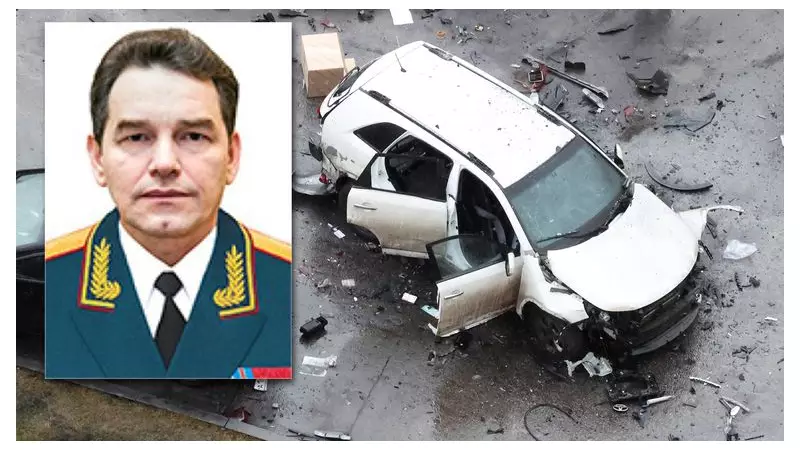
A senior Russian military commander has been assassinated in a car bomb attack in the capital, marking the latest in a string of targeted killings of high-ranking officers since the onset of the war in Ukraine.
Details of the Southern Moscow Attack
Lieutenant General Fanil Sarvarov, who led the Operational Training Directorate within the Russian Armed Forces' General Staff, was killed when his vehicle exploded in southern Moscow. The incident, which occurred on Monday 22 December 2025, represents the third such assassination of a senior military figure within a year.
Russian authorities have pointed the finger at Kyiv. Svetlana Petrenko, a spokesperson for Russia's investigative committee, stated that one active line of inquiry is that the murder was orchestrated by Ukrainian intelligence services. "Investigators are pursuing numerous lines of inquiry regarding the murder. One of these is that the crime was orchestrated by Ukrainian intelligence services," she said.

Pattern of Assassinations and Kremlin Response
Moscow has repeatedly blamed Ukraine for the assassinations of military officers and public figures on Russian soil since the full-scale invasion began nearly four years ago. While Ukraine has claimed responsibility for some previous attacks, it has not commented on the death of General Sarvarov.
Kremlin spokesman Dmitry Peskov confirmed that President Vladimir Putin was informed immediately of the killing. Sarvarov was a veteran of conflicts in Chechnya and had participated in Russia's military campaign in Syria.
This attack follows a similar pattern from just over a year ago, when Lt Gen Igor Kirillov, chief of Russia's nuclear, biological and chemical protection forces, was killed by a bomb hidden on an electric scooter. Ukraine's security service claimed responsibility for that attack, after which an Uzbek national was arrested and charged with carrying out the killing on its behalf. President Putin labelled Kirillov's death a "major blunder" by Russian security agencies.
Broader Context: Hybrid Warfare and Diplomatic Tensions
Ukraine, facing a larger and better-equipped Russian military, has frequently employed unconventional tactics to shift the conflict's dynamics. Meanwhile, Western officials have accused Russia of waging its own campaign of sabotage and disruption across Europe to undermine support for Ukraine, allegations which Moscow denies.
In a related diplomatic development, Russian Deputy Foreign Minister Sergei Ryabkov stated that Moscow is prepared to legally confirm it has no intention of attacking NATO or the European Union. He claimed significant risks of a clash with the alliance remain due to what he called hostile actions by European countries, but insisted Russia was "even ready to legally enshrine this" commitment.
The assassination of General Sarvarov underscores the ongoing shadow war extending far beyond the conventional battlefield, raising tensions and highlighting the persistent volatility in relations between Russia and the West.






