

Russia's Deadliest Attack on Ukraine This Year Kills 17, Injures Over 100
Russia has carried out its deadliest attack against Ukraine this year, killing at least 17 people and injuring more than 100 in a massive wave of drone and missile strikes across the country. The assault, which occurred early Thursday, involved nearly 700 drones and dozens of ballistic and cruise missiles, according to Ukraine's air force.
Casualties and Damage Across Ukraine
The southern port city of Odesa suffered the heaviest losses, with nine fatalities reported. In the capital Kyiv, four people were killed, including a 12-year-old boy. The Dnipropetrovsk region recorded three deaths, and another person died in Zaporizhzhia oblast. The attack marked the largest assault in weeks, following a March strike that saw 948 drones and 34 missiles fired in 24 hours.
An air-raid alarm sounded in Kyiv around 2:30 am, followed by explosions and loud booms from Ukrainian air defenses. Mykhailo Barvinko, a 27-year-old PhD student in Kyiv's Podilskyi district, described the terrifying moment: "I heard the air-raid alarm and was about to go down to the bomb shelter when my windows blew in. There was a flash and two seconds later an enormous blast wave." Barvinko was unhurt but his apartment was damaged.

Survivor Accounts and Civilian Impact
Another survivor, Olena, recounted being awakened by incoming missiles after dozing off following initial drone attacks. "It was 6:53 am. My clock fell over, the battery fell out and I happened to see the time. We were very scared and heard plaster falling. Our windows got damaged," she said. The attacks injured three police officers and four medical workers in Kyiv who were caught in a second "double tap" bombardment after responding to the initial strikes.
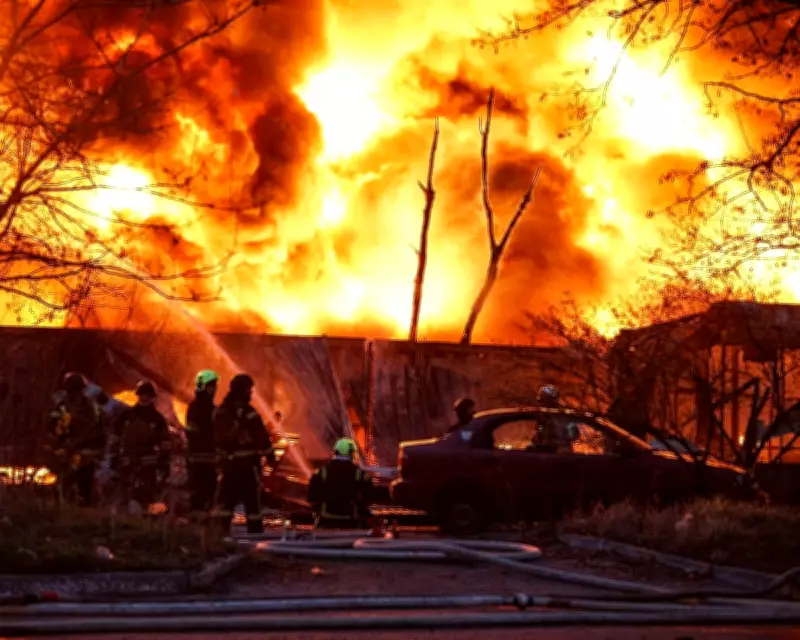
As dawn broke, thick black smoke billowed above Kyiv while rescuers swept up glass and cordoned off a three-meter-long enemy missile lying in a courtyard. Russia has repeatedly targeted civilian buildings and critical infrastructure since Vladimir Putin's 2022 full-scale invasion, with attacks worsening since Donald Trump returned to the White House last year, leading to prolonged blackouts this winter in Kyiv and other cities.
Zelenskyy's Warning and International Response
The latest strikes came soon after Ukrainian President Volodymyr Zelenskyy warned that Ukraine had practically run out of US-made Patriot air-defense missiles. "The situation is in such a deficit, it could not be any worse," he said last week. Ukraine has ruefully noted that hundreds of Patriots were used up in the first days of the Iran war, leaving fewer advanced US missiles available for Kyiv's defense.
Zelenskyy traveled to Germany, Norway, and Italy this week in an effort to boost his country's air defenses. Accepting an award in the Netherlands on Thursday, he described Putin as a global threat and urged continued international support. "Another night has proven that Russia does not deserve any easing of global policy or lifting of sanctions," Zelenskyy wrote on social media.
Ukrainian Counterstrikes and Regional Impact
Meanwhile in Russia, the regional governor of Krasnodar claimed that a 14-year-old girl and a woman were killed in Ukrainian strikes on the Black Sea port of Tuapse, damaging apartment buildings and houses. Ukraine's military confirmed hitting infrastructure in Tuapse as part of its campaign against Russian oil facilities used to finance the Kremlin's war, also striking two oil depots in Russian-occupied Crimea.
Tuapse serves as a major southern port for Russia, functioning as an oil product export hub and handling dry bulk cargo like coal and fertilizer. It is home to an oil refinery owned by Rosneft, Russia's largest oil producer. Ukraine's foreign minister, Andrii Sybiha, condemned the Russian attacks as war crimes that must be stopped, writing: "Such attacks cannot be normalised. These are war crimes that must be stopped and their perpetrators held to account."






