

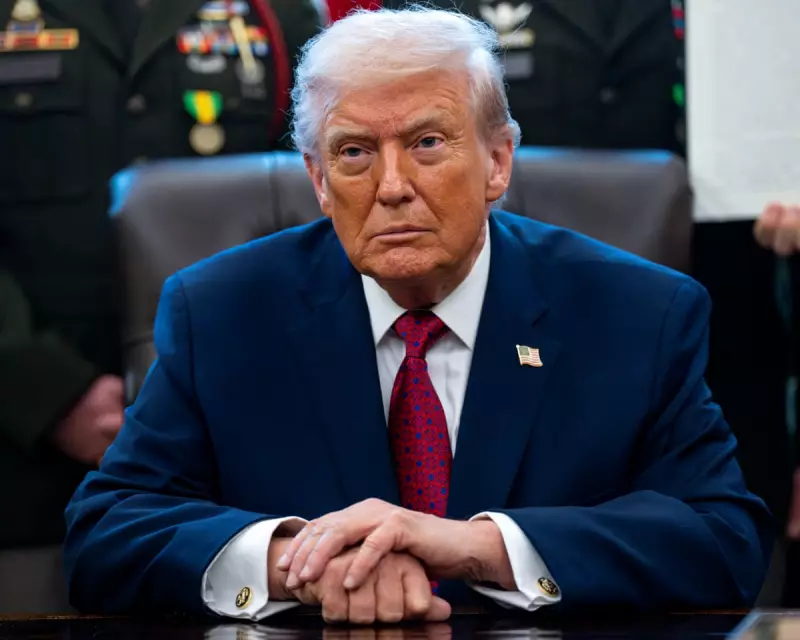
In a significant escalation of the United States' war on drugs, President Donald Trump has signed an executive order formally designating the synthetic opioid fentanyl as a "weapon of mass destruction". The move, enacted at the White House on Monday, reclassifies the lethal narcotic not merely as an illegal drug but as a potential chemical weapon.
A New Front in the Drug War
The executive order directs the Pentagon and the Department of Justice to implement additional measures to combat the production and distribution of fentanyl. The White House stated the designation "unleashes every tool to combat the cartels and foreign networks" responsible for the drug's proliferation. It further warned that fentanyl could be weaponised by organised adversaries to carry out "concentrated, large-scale terror attacks".
"Illicit fentanyl is closer to a chemical weapon than a narcotic," the order declared. Historically, US policy has defined a weapon of mass destruction as a radiological, chemical, biological, or other device intended to harm a large number of people. It is already a federal crime to threaten to use such weapons.

Scepticism from Policy Experts
However, the administration's assertion that fentanyl poses a direct weaponisation threat has been met with scepticism from drug policy specialists. Jonathan Caulkins, a professor at Carnegie Mellon University who researches drugs and crime, expressed doubt, telling Stat News: "Neither terrorist organisations nor militaries are using fentanyl as a weapon. It is not obvious to me that this is a threat."
The immediate policy impact of the order remains unclear. It follows a pattern of increasingly militaristic tactics from the Trump administration. Earlier this year, it moved to designate powerful drug cartels as foreign terrorist organisations, providing a potential legal justification for military action.
Military Strikes and Broader Strategy
Since early September, US forces have conducted more than 20 strikes against suspected drug-smuggling vessels in the Caribbean and Pacific, resulting in the deaths of more than 80 individuals. Military analysts note that cartel boats in the Caribbean typically transport cocaine, while fentanyl bound for the US is mainly sourced from China and trafficked through Mexico. Little public evidence has been provided to confirm the stricken vessels were carrying drugs.
President Trump has repeatedly threatened strikes on land in countries including Venezuela, Colombia, and Mexico to combat trafficking. In a recent strategy document, he emphasised reasserting US dominance in the Western Hemisphere as a foreign policy priority.
While fentanyl is a leading cause of overdose deaths in America, fatalities have been declining in recent years. The administration has sought to address the crisis through trade policies, harsher criminal penalties, and by controversially linking trafficking to undocumented immigration to justify stricter enforcement.
Concurrently, public health experts have criticised the administration for undermining domestic addiction treatment efforts. They point to cuts in staff and resources at key federal agencies overseeing drug policy, the withholding of funding from harm reduction organisations, and potential cuts to Medicaid, which could devastate access to substance abuse treatment for low-income Americans.






