

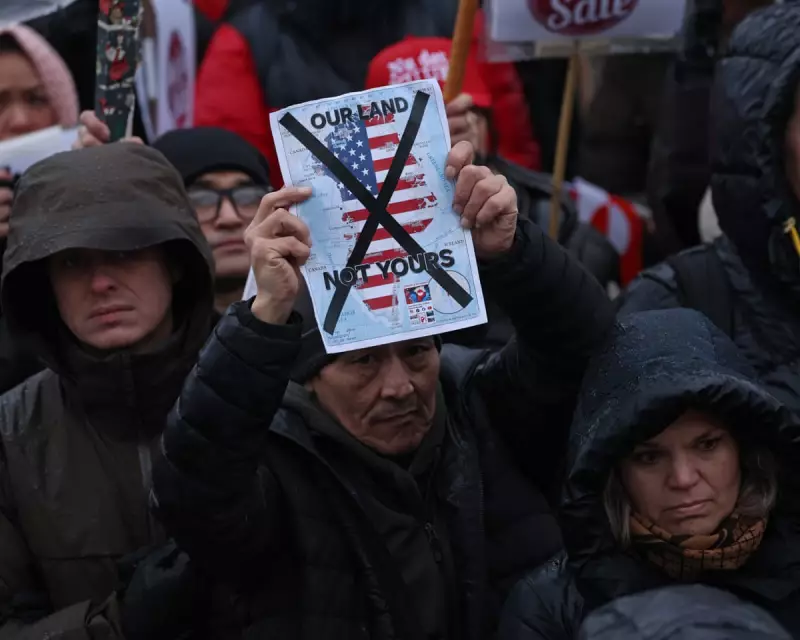
Residents of Nuuk, Greenland's capital, have taken to the streets in vocal protest against former US President Donald Trump's controversial plans to assert control over their autonomous territory. The demonstrations highlight growing international concern over Trump's increasingly unpredictable approach to global affairs during his second administration.
A Foreign Policy Driven by Whims, Not Strategy
One year into Trump's second term, coherent American foreign policy appears to have been replaced by a pattern of erratic decisions and personal grievances. World leaders are grappling with an administration that operates more like a "mad king's court" than a traditional government, where international relations are subject to sudden shifts based on the president's moods and legacy ambitions.
Recent Diplomatic Turmoil
The past week alone has demonstrated this chaotic approach. Trump sent a remarkable text to Norwegian Prime Minister Jonas Gahr Støre declaring that, having been overlooked for the Nobel Peace Prize, he no longer felt obligated to prioritise peace above American interests. In the same message, he asserted that global security depended on "Complete and Total Control of Greenland."

Danish Prime Minister Mette Frederiksen has warned that any US takeover of Greenland would effectively spell the end of NATO, setting the stage for tense discussions at this week's World Economic Forum in Davos. Meanwhile, when French President Emmanuel Macron attempted to organise a G7 meeting to address differences, Trump leaked their private conversation.
Undermining International Institutions
Simultaneously, Trump has invited Russian President Vladimir Putin to join a vaguely defined "board of peace" intended to oversee Gaza's transition to lasting peace, despite Russia's ongoing invasion of Ukraine. This move appears designed to undermine the United Nations, which has served as a cornerstone of international order since World War II. When informed Macron might boycott this initiative, Trump threatened to impose 200% tariffs on French wine and champagne.
Further illustrating this unconventional approach, Trump was photographed last week beaming as Venezuelan opposition leader María Corina Machado presented him with her Nobel Peace Prize medal. The transfer followed considerable pressure, with critics questioning the appropriateness of the display.
Legacy Hunting on the World Stage
Analysts suggest Trump's frenetic foreign policy activity stems from his preoccupation with securing a historical legacy. Facing domestic resistance to electoral law changes and immigration enforcement measures, the president has turned increasingly toward international affairs as an alternative arena for achievement.
"For the president, the question of legacy is important, which is why we've seen so much foreign policy activity in this term, unlike the first," observed Kristine Berzina, senior fellow for US defence and transatlantic security at the German Marshall Fund. "Efforts at peace, efforts at regime change and efforts at territorial acquisition are all part of a notion of legacy. And there isn't that much time."
A Year of Controversial Actions
Trump's 2025 foreign policy record includes several contentious achievements:
- The legally dubious capture and rendition of Venezuelan leader Nicolás Maduro
- A fragile Gaza peace agreement that essentially gave Israel free rein
- Military strikes against nuclear sites in Iran during Israel's conflict with Tehran
- An ineffective campaign against Houthi rebels in Yemen
- Successfully pressuring NATO allies to increase defence spending while straining relations through tariffs and migration rhetoric
The Greenland Gambit
Trump's Greenland ambition represents perhaps the most striking example of his administration's new approach. His treasury secretary, Scott Bessent, has framed the potential acquisition in stark terms: "Better now peace through strength, make it part of the United States, and there will not be a conflict because the United States right now, we are the hottest country in the world."

Vice President JD Vance and Secretary of State Marco Rubio recently met with Danish and Greenlandic foreign ministers, with Vance reportedly seeing an opportunity to further strain transatlantic relations. For Trump, however, the motivation appears more fundamental.
"Greenland for the sake of territory, Greenland for the sake of how you transform a map, Greenland for a sake of legacy," explained Berzina. "Those are the primary objectives."
A Zero-Sum Worldview
This approach reflects what analysts describe as a 19th-century imperial mindset in a 21st-century world. Max Bergmann, director of the Europe, Russia, and Eurasia programme at the Center for Strategic and International Studies, notes: "What you see now is simply just everything could be justified in pure power terms, and that's very new for the United States ... that's not really something we've done for the last 80 years."
The administration's decision-making process has become increasingly centralised, with key foreign policy choices mediated by a small group including Vance, Rubio, deputy chief of staff Stephen Miller, envoy Steve Witkoff, and chief of staff Susie Wiles. Despite differing priorities, these figures have found common cause on issues from Venezuela to Greenland.
Unpredictability as Policy
The volatility extends beyond specific initiatives to fundamental questions of reliability. In May 2025, Trump approved a UK plan to return the Chagos Islands to Mauritius, with Rubio praising the "monumental achievement." A year later, Trump denounced the same agreement as an "act of GREAT STUPIDITY," citing it as further justification for demanding Greenland.
This pattern suggests that in Trump's evolving world order, all agreements and alliances remain perpetually vulnerable to presidential whims. As the president himself declared: "These are International Powers who only recognise STRENGTH, which is why the United States of America, under my leadership, is now, after only one year, respected like never before."
With three years remaining in his term and challenging midterm elections approaching, world leaders face the unsettling prospect of an American foreign policy guided not by strategic consistency but by personal legacy ambitions and unpredictable impulses.





