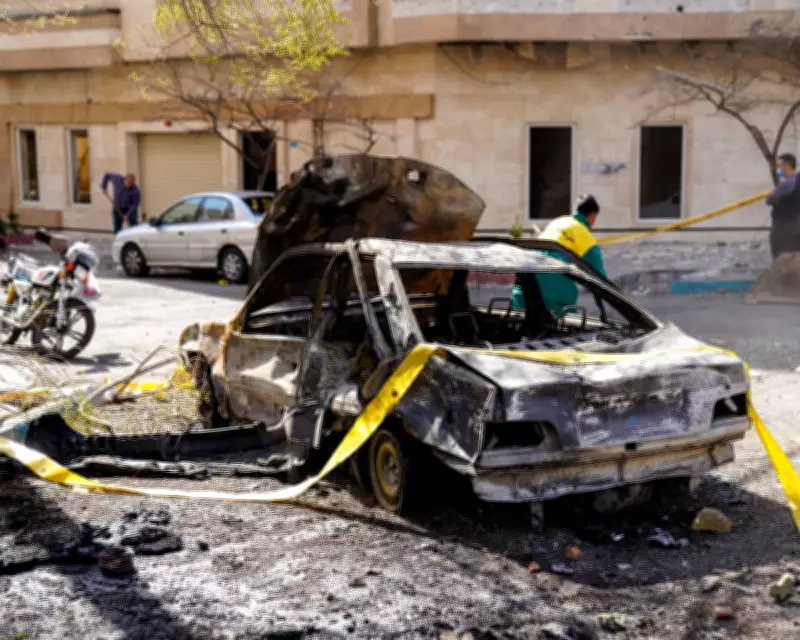
Daylight Assault on Tehran Government Zone
In an unprecedented daylight military operation, United States and Israeli forces launched coordinated strikes against Tehran's government district at approximately 9:15 AM local time, targeting key leadership compounds and administrative buildings while civilians were beginning their workday. The assault marked a significant departure from conventional nighttime bombing campaigns, with plumes of smoke rising from the Iranian capital's government zone and affluent residential areas as explosions rocked Pasteur Street.
Decapitation Strategy Targets Leadership
Israeli officials confirmed the initial salvo represented a decapitation strike specifically designed to eliminate Iran's leadership structure. The timing ensured government officials would be present at their desks, maximizing potential impact on the regime's operational capacity. Satellite imagery revealed extensive damage to the supreme leader's compound, though Iranian news agencies maintained Ayatollah Ali Khamenei remained safe at an undisclosed location.
Multiple government facilities sustained direct hits, including offices of President Masoud Pezeshkian, national security headquarters, and the assembly of experts responsible for selecting future supreme leaders. The former presidential residence of Mahmoud Ahmadinejad was completely destroyed, with his status remaining unknown following the attack.

Civilian Casualties Mount Across Iran
As ambulances evacuated injured civilians from the Pasteur district, reports emerged of simultaneous strikes in Qom, Tabriz, Kermanshah, Lorestan Khorramabad, and Karaj. The state-run IRNA news agency confirmed at least 40 fatalities when an Israeli missile struck a girls' elementary school in Minab, Hormozgan province, where Revolutionary Guard facilities are located.
The daylight timing significantly increased civilian exposure, with children arriving at schools and workers commuting to offices during peak morning hours. Iranian authorities reported mounting casualties as rescue operations continued throughout affected urban centers.
Regime Change Objectives Explicitly Stated
Israeli intelligence agency Mossad published a Farsi-language social media message explicitly calling for Iranian citizens to overthrow their government, stating: "Our Iranian brothers and sisters, you are not alone! Together we will return Iran to its glorious days." This message was subsequently reinforced by President Donald Trump in a pre-recorded address broadcast via Truth Social.
Trump's eight-minute declaration announced "major combat operations in Iran" and directly urged Iranian citizens to "take over your government" once military operations concluded. The president framed the intervention as defensive action against "imminent threats" while positioning the conflict as a potential turning point for regime change.
Military Coordination and Operation Names
The Pentagon designated the campaign "Operation Epic Fury" while Israel announced "Operation Roaring Lion," complete with official branding featuring the Star of David flag and a roaring lion emblem. Israeli Prime Minister Benjamin Netanyahu released a statement synchronized with Trump's address, thanking the American president for leadership and defining the war's objective as "removing the existential threat posed by the terrorist regime in Iran."
Military officials revealed extensive joint planning spanning several months, with timing influenced by multiple geopolitical factors. The arrival of the USS Gerald Ford aircraft carrier in Haifa completed what Trump described as the largest Middle Eastern military buildup since the Iraq invasion twenty-three years earlier.
Diplomatic Efforts Collapse Amid Escalation
Recent negotiations between US envoy Jared Kushner, special representative Steve Witkoff, and Iranian Foreign Minister Abbas Araghchi concluded in Geneva without agreement, despite Omani mediators reporting "good progress." Omani Foreign Minister Badr Albusaidi made an urgent Washington visit to plead for extended diplomacy but awoke to news of the bombing campaign.

Albusaidi expressed profound disappointment, stating: "Active and serious negotiations have yet again been undermined. Neither the interests of the United States nor the cause of global peace are well served by this." His warning arrived too late to prevent regional escalation.
Iranian Retaliation Ignites Regional Conflict
Within hours of the Tehran strikes, Iran launched comprehensive missile retaliation targeting US military bases across Gulf states and Israeli positions. Explosions were reported in the United Arab Emirates, Bahrain, Qatar, and Kuwait, with significant damage to the US base south of Manama and Dubai's Fairmont hotel on Palm Jumeirah.
The United Arab Emirates confirmed successful missile interceptions but reported one fatality from falling debris in Abu Dhabi. Bahrain initiated civilian evacuations near affected military installations as the conflict rapidly expanded beyond Iranian borders.
Political Fallout and Congressional Response
Members of Congress awoke to news of expanding regional warfare conducted without formal legislative authorization. Senate Armed Services Committee ranking Democrat Jack Reed condemned the unilateral action, stating: "Against the clear wishes of the American people, President Trump has thrust our nation into a major war with Iran—one he never made a case for, never sought congressional authority for, and for which he has no endgame."
As night fell on Tehran, uncertainty prevailed regarding leadership casualties and the conflict's ultimate trajectory. Iranian parliament security commission chair Ebrahim Azizi warned: "We warned you, but now you have started down a path that is beyond your control," reflecting the unpredictable escalation triggered by coordinated US-Israeli military action.