

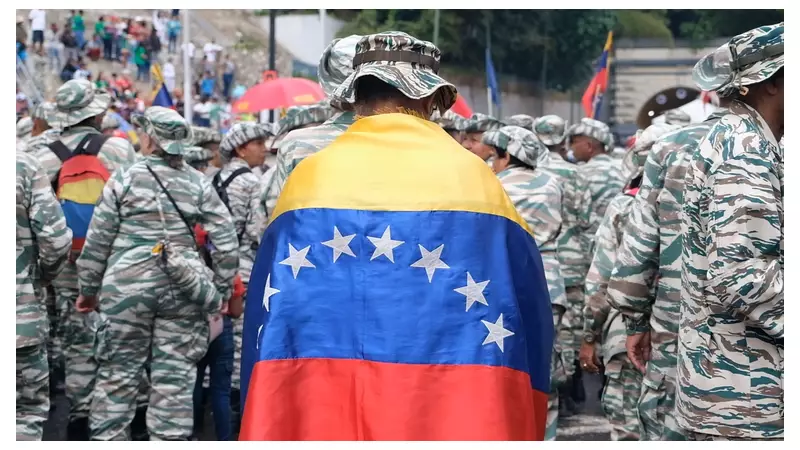
Venezuela stands at a perilous crossroads, with its government under intense pressure from the United States to relinquish power, backed by stark threats of military force. Sky News chief correspondent Stuart Ramsay travelled to the capital, Caracas, on Monday 22 December 2025, to witness life as tensions with Washington reach a critical peak.
A Capital Under Pressure
The United States has declared its target is Venezuela's alleged government-run drug trafficking network, which it claims operates as a narco cartel led by the country's nominal president, Nicolas Maduro. This accusation forms the basis for the escalating rhetoric, including the potential for military action. Across the Avila mountain from Caracas, the United States military has stationed a significant portion of its navy in the Caribbean, a constant and visible reminder of the threat.
Reporting from the city is fraught with danger. Local journalists face immense challenges, and foreign crews must operate with extreme discretion. Our team restricted open filming, conducting interviews indoors with trusted contacts or discreetly from vehicles, capturing the tense atmosphere on the streets where markets and Christmas shoppers maintain a fragile veneer of normality.

Caracas, a city of stunning geography stretched along a valley beneath the 8,000-foot Avila mountain, bears the scars of economic collapse. Despite sitting on the world's largest known oil reserves, mismanagement and corruption have plunged most of its population into poverty, stripping the once-booming metropolis of its 1970s sheen.
Maduro's Defiance and the People's Struggle
President Maduro projects an image of business as usual, recently seen dancing and singing at a rally in Caracas. His supporters, bussed in from community groups, militias, and government sectors, echo his defiance. "They will always try to lay their hands on Venezuela's riches, but they won't get away with it," one told Sky News, framing the crisis as a battle for national sovereignty and resources like oil and minerals.
However, the rally's turnout was notably small on a rainy day, a fact opponents and the US point to as evidence of his dwindling popular support and the allegedly rigged 2024 election. For many citizens, the grand geopolitical standoff is a distant concern. "Many don't believe that all this talk of war is even a 'thing'," Ramsay reports, with people focused overwhelmingly on economic survival.
The internal reality is stark. Maduro's promised socialist vision has crumbled, leaving a legacy of collapsed health services, education, and industry. More than a quarter of the 29 million population have fled. Those remaining, like 71-year-old Orlando, often live in abject poverty in cramped *barrios*. "It was wonderful, you made lots of money," he recalls of the past, contrasting it with the present: "Now… there is no life."
A Deepening Police State
Beneath the surface, Venezuela operates as a hardened police state. The presidential palace, Mira Flores, is heavily fortified, with rumours that Maduro sleeps in a different location each night. Checkpoints and arbitrary detentions are commonplace, the primary mechanism for stamping out dissent.
Since 2014, human rights groups have documented more than 18,000 politically motivated arrests, with a significant spike after the 2024 elections. At the offices of Foro Penal, an NGO defending political prisoners, cabinets are overflowing with case files. Lawyer Gonzalo Himiob describes a deliberate strategy of neutralisation. "They want to neutralise these people… using the criminal process to keep them in jail and not on the streets," he explains.
The government has increasingly levelled charges of "terrorism" against opponents since 2024. Himiob states this is a clear manoeuvre to frame all protest as terrorism. In some cases, whole families are detained if the primary target cannot be found, sending a chilling message to would-be demonstrators. The last major opposition rally was in January, supporting Nobel Peace Prize laureate Maria Corina Machado, which triggered a fresh wave of arrests.

The pervasive fear is palpable. People are "genuinely scared of stepping out of line," Ramsay concludes, watched over by a state whose stranglehold on dissent is only tightening as it clings to power. Exhausted by years of economic hardship, most Venezuelans in Caracas see little hope for change, trapped between international threats and domestic repression.





