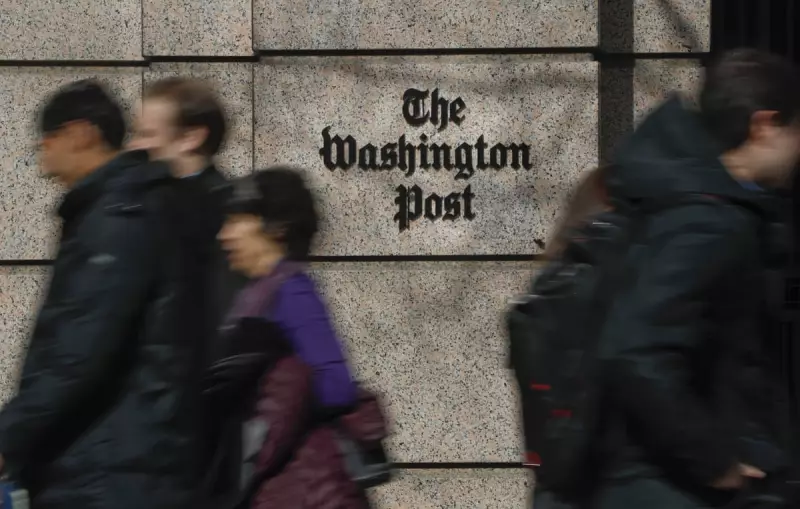
Washington Post Takes Legal Action Over Reporter's Seized Electronics
The Washington Post has launched a significant legal challenge against the United States government, demanding the immediate return of electronic devices seized from the home of one of its reporters during what the newspaper describes as an "outrageous" raid.
Unprecedented Seizure of Journalistic Materials
In a dramatic escalation of tensions between media organisations and federal authorities, the FBI conducted what press freedom groups have called a "highly unusual and aggressive" raid on the apartment of Washington Post reporter Hannah Natanson last week. During this operation, government agents seized two laptops, two mobile phones, a Garmin smartwatch, and various other electronic devices belonging to the journalist.
The seizure forms part of an investigation into a government contractor's alleged retention of classified materials, but the Washington Post argues that the action represents a dangerous overreach that threatens fundamental press freedoms protected by the First Amendment of the US Constitution.

Legal Battle in Virginia Federal Court
The newspaper has filed two separate motions in the United States District Court for the Eastern District of Virginia, requesting that the court compel the government to return all seized materials immediately. Furthermore, the Post has asked for a judicial order instructing authorities to keep copies of the material under seal and refrain from reviewing them until the legal matter is fully resolved.
In their court filings, lawyers representing the Washington Post stated emphatically: "The outrageous seizure of our reporter's confidential newsgathering materials chills speech, cripples reporting, and inflicts irreparable harm every day the government keeps its hands on these materials." They warned that failing to return the devices would effectively license future newsroom raids and normalise censorship through search warrants.
Profound Implications for Press Freedom
Bruce D Brown, president of the Reporters Committee for Freedom of the Press, highlighted the unprecedented nature of this situation in a statement released on Wednesday. "This is the first time in US history that the government has searched a reporter's home in a national security media leak investigation, seizing potentially a vast amount of confidential data and information," he declared.
The Washington Post has revealed that the seized devices contain years of information about past and current confidential sources, along with unpublished newsgathering materials that Natanson was actively using for current reporting assignments. According to the newspaper, only a minimal portion of the seized material relates to the specific warrant issued in connection with the government contractor investigation.
Impact on Journalistic Work and Source Relationships
Since the raid occurred, Hannah Natanson has been unable to publish any stories, and the Washington Post argues that she has lost the ability to communicate securely with her confidential sources. The newspaper's legal team expressed concern that "Nor are Natanson's confidential sources likely to work with her again, if the government is permitted to rummage through her files unchecked."
Natanson, who has extensively covered how the Trump administration reshaped the federal government, published a first-person essay in late December detailing her reporting process and interactions with anonymous government sources. Her work has focused on significant governmental transformations during the previous administration.
Government Defence and Broader Context
Attorney General Pam Bondi has defended the raid, appearing on Fox News to argue that "The First Amendment is a bedrock principle, but this isn't about that. This is about classified material that could jeopardise lives." This defence highlights the tension between national security concerns and press freedom protections that lies at the heart of this legal confrontation.

The government contractor at the centre of the investigation, Aurelio Perez-Lugones, remains in federal custody in Maryland, charged with unlawfully retaining national defence information. Meanwhile, press freedom organisations continue to advocate for greater transparency, with the Reporters Committee for Freedom of the Press having filed a memorandum urging the unsealing of all judicial records related to the raid on Natanson's home.
This case represents a critical test of press freedom protections in the United States, with potential ramifications that could extend far beyond this specific incident to affect how journalists nationwide conduct their work and protect their sources in an increasingly complex legal environment.