

European leaders have been left deeply divided and conflicted in the wake of the United States' military operation to capture Venezuela's authoritarian president, Nicolás Maduro. While many welcomed the end of his regime, they are simultaneously grappling with the profound challenge of upholding the established principles of international law, which appear to have been breached by Washington's actions.
A Clash of Principles: Democratic Transition vs. Sovereign Rights
The core of Europe's dilemma lies in squaring its long-held desire for a democratic transition in Venezuela with the legal framework that governs state sovereignty. The continent had not recognised Maduro as Venezuela's legitimate leader since the June 2024 elections, which were widely condemned as fraudulent. However, Donald Trump's subsequent rejection of the Nobel prize-winning opposition figure, María Corina Machado – whom Europe has embraced – created immediate awkwardness.
Further complicating matters is the US justification. American officials claimed the operation was an act of self-defence, alleging Maduro's government was involved in drug-trafficking. This rationale has been met with sharp criticism from international legal experts. Oona Hathaway, a Yale professor of international law, stated she saw no plausible justification under the UN charter for the US use of force. "If drug trafficking is a reasonable justification for attacking another country then a whole range of possible arguments can be made that basically mean that self-defence is no longer a real exception. It’s the new rule," she warned, calling the action a significant breach of international law.

A Mosaic of European Reactions: From Silence to Outright Criticism
The response across European capitals has been a patchwork of cautious statements, ideological alignment, and muted criticism, often tempered by a reliance on US support for Ukraine.
Some leaders, like Kyriakos Mitsotakis, the Prime Minister of Greece, focused solely on welcoming Maduro's departure while sidestepping the legality. "This is not the time to comment on the legality of the recent actions," he stated. Similarly, the German Chancellor, Friedrich Merz, called the legal assessment "complex," and UK Prime Minister Keir Starmer mentioned international law but did not apply it to this specific instance.
In contrast, Giorgia Meloni, the Italian Prime Minister and a closer ideological ally of Trump, deemed the operation a legitimate "defensive intervention." The clearest condemnation came from Jean-Noël Barrot, the French Foreign Minister, who asserted that capturing Maduro "violates the principle of non-use of force that underpins international law." He warned that such violations by permanent UN Security Council members would have "heavy consequences for world security."
EU figures attempted to bridge the gap. The EU's foreign affairs chief, Kaja Kallas, and Commission President, Ursula von der Leyen, both called for a democratic transition while stressing that any solution must respect international law and the UN Charter.
The Dawn of a New, Unstable World Order
The events in Venezuela signal a potential shift in global power dynamics. Analysts suggest the episode cements a new system where the naked self-interest of a few "great powers" dominates, rendering the post-war framework of multilateralism increasingly fragile. The US Secretary of State, Marco Rubio, explicitly threatened that Cuba could be next, stating its leaders should be "a little worried."
This new reality forces a sobering reflection on the failures of existing international institutions. As noted by Nizar El Fakih of the Atlantic Council, multilateralism failed to deliver a peaceful transition for Venezuela despite years of appeals, and the International Criminal Court has yet to issue a single indictment related to crimes against humanity in the country despite extensive evidence.

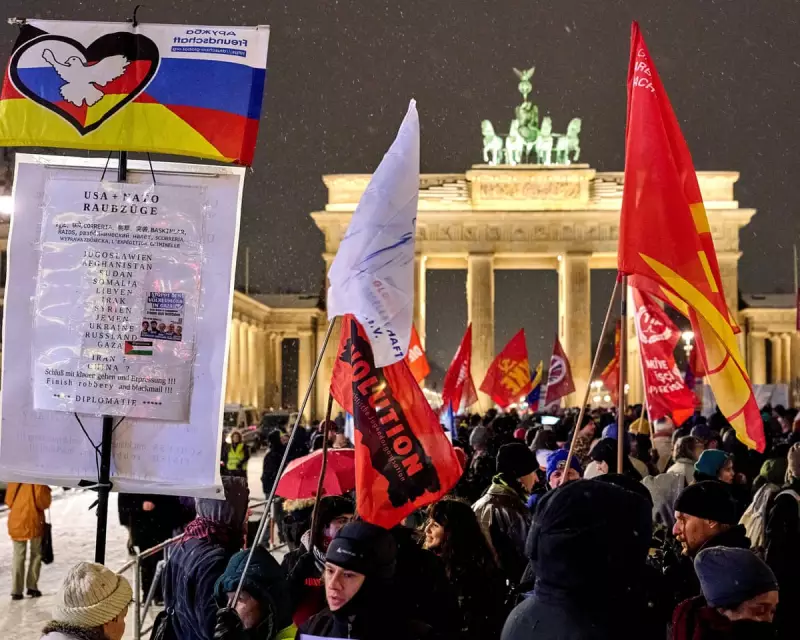
The rallying cry of "hands off Venezuela" heard at protests, such as one near the US embassy in Berlin, underscores the public divide. For European leaders, the Venezuela crisis is not just about one South American nation; it is a pivotal test of a world order where the rule of law is being supplanted by a doctrine where might makes right.





